> For the complete documentation index, see [llms.txt](https://docs.betterbuilding.io/llms.txt). Markdown versions of documentation pages are available by appending `.md` to page URLs; this page is available as [Markdown](https://docs.betterbuilding.io/user-guide/tools-and-plugins/ashrae-62.1-2022-outdoor-air-calculator.md).
# ASHRAE 62.1-2022 Outdoor Air Calculator
Beta Version 1.0 I 12/01/2026
### What is this tool?
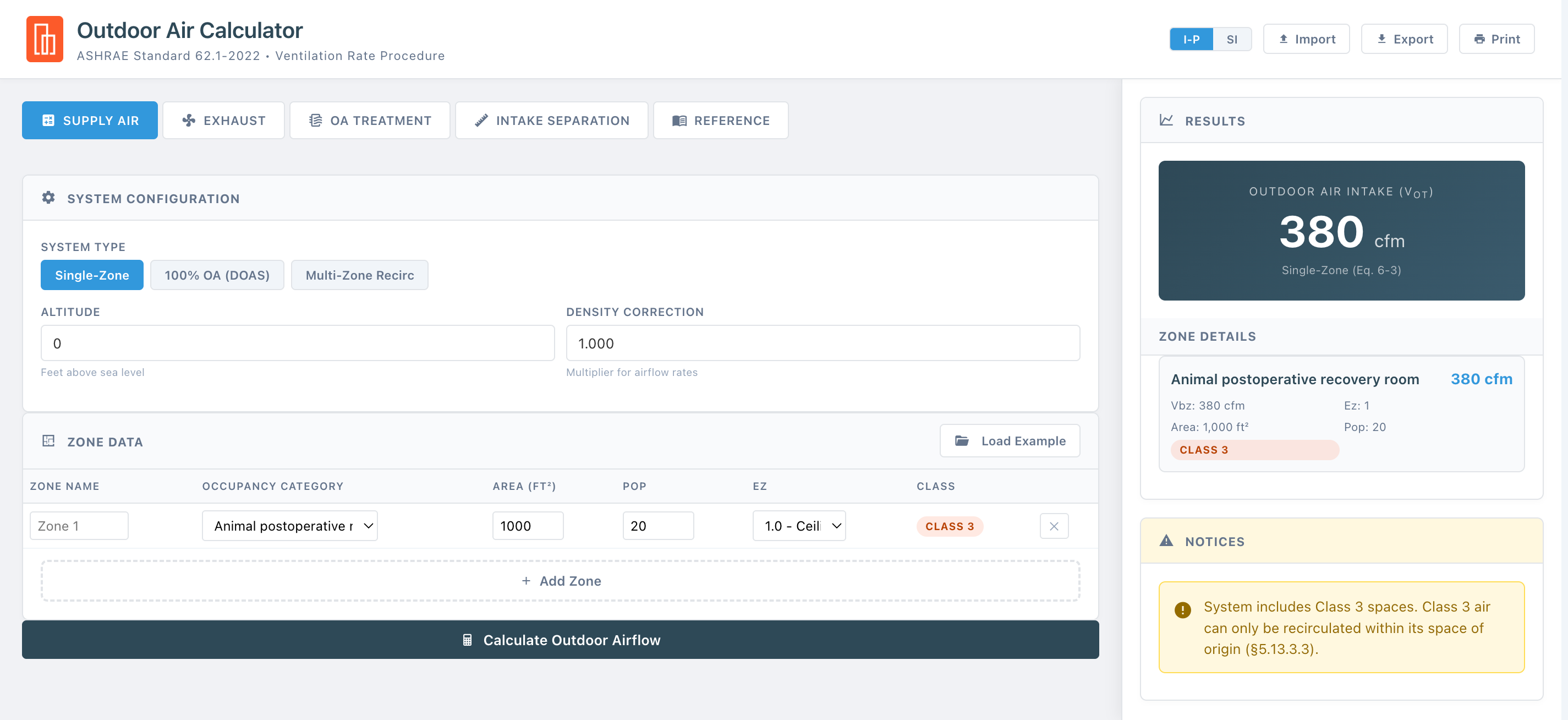
The ASHRAE 62.1-2022 Outdoor Air Calculator determines minimum outdoor air ventilation rates using the Ventilation Rate Procedure from ANSI/ASHRAE Standard 62.1-2022. This is the calculation that drives HVAC system sizing, duct design, and code compliance documentation for commercial and institutional buildings.
The calculator implements:
* **Section 6.2**: Complete Ventilation Rate Procedure
* **Table 6-1**: All 80+ occupancy categories with Rp/Ra values
* **Table 6-2**: Exhaust requirements for spaces requiring dedicated exhaust
* **Table 6-3**: Airstream classifications (Classes 1-4)
* **Table 6-4**: Zone air distribution effectiveness values
* **Section 6.1.4**: Outdoor air treatment requirements for nonattainment areas
* **Normative Appendix A**: Alternative Procedure for multi-zone system ventilation efficiency
* **Normative Appendix B**: Separation distance calculations between intakes and exhausts
* **Normative Appendix C**: CFD-based Ez determination methodology
* **Normative Appendix D**: Outpatient facility ventilation rates
What it does not cover: the Indoor Air Quality Procedure (Section 6.3), the Natural Ventilation Procedure (Section 6.4), healthcare facilities within the scope of ASHRAE/ASHE Standard 170, or residential ventilation (that falls under ASHRAE 62.2). Different standards for different problems.
***
### What it is / What it isn't
**This tool is:**
* A calculation aid for determining code-minimum outdoor air rates per ASHRAE 62.1-2022
* Useful for preliminary design, energy modeling inputs, and compliance documentation
* A reference for Table 6-1, 6-2, 6-3, and 6-4 values without flipping through the standard
**This tool is not:**
* A substitute for engineering judgment
* A guarantee of code compliance (local amendments exist, AHJ interpretations vary)
* A sizing tool for air handling equipment (that requires load calculations)
* Appropriate for spaces covered by ASHRAE 170 (hospitals, surgical suites, etc.)
***
### System Requirements
**Browser:** Any modern browser with JavaScript enabled. Chrome, Firefox, Edge, Safari all work fine.
**Network:** Not required after initial page load. The tool runs entirely in your browser.
**Files:** Single standalone HTML file. No installation, no dependencies, no server needed. Download it, open it, use it.
***
### Quick Start: Single-Zone System
**Time: 2 minutes**
One air handler serving one ventilation zone. The simplest case, covered by Equation 6-3.
**Step 1:** Leave system type set to "Single-Zone System"
**Step 2:** Click the Occupancy Category dropdown and select your space type
The calculator auto-populates the default occupant density from Table 6-1. For an office, that's 5 people per 1000 ft². For a lecture hall, 150 per 1000 ft². These defaults represent typical conditions. Adjust if your project differs.
**Step 3:** Enter your floor area
**Step 4:** Adjust population if needed
The calculator auto-calculates population from area × default density. Override this if you know actual design occupancy.
**Step 5:** Select zone air distribution effectiveness (Ez)
Table 6-4 values are in the dropdown. For most ceiling supply cooling systems, Ez = 1.0. For warm air ceiling supply with ceiling return, Ez can drop to 0.8. The selection matters because Voz = Vbz / Ez.
**Step 6:** Click "Add Zone" then "Calculate Outdoor Airflow"
Result shows Vot in cfm (or L/s if you've toggled to SI units). This number goes on your mechanical schedules, into your energy model, and onto compliance forms.
***
### Quick Start: Multi-Zone Recirculating System
**Time: 5 minutes**
The typical commercial building scenario. One air handler serves multiple zones with different ventilation requirements: offices, conference rooms, break rooms, corridors. VAV systems, multi-zone units, fan-powered boxes. Equations 6-5 through 6-10 apply.
**Step 1:** Select "Multi-Zone Recirculating" from the system type dropdown
**Step 2:** Add each ventilation zone
Click through each zone the AHU serves. Open office east wing, conference room A, break room, corridors. Each gets its own occupancy category, area, and population.
**Step 3:** Enter System Population (Ps)
This is peak simultaneous occupancy across all zones served by the system. Usually less than the sum of individual zone peaks because the conference room isn't full while the break room is also packed. If you leave this at zero, the calculator assumes no diversity (Ps = ΣPz), which is conservative.
**Step 4:** Select calculation method
Two choices:
* **Simplified Procedure (Section 6.2.4.3)**: Uses Equations 6-7 and 6-8 to determine system ventilation efficiency based on diversity ratio. Quick, conservative, appropriate for most projects.
* **Alternative Procedure (Appendix A)**: Calculates zone-by-zone ventilation efficiency. Can result in lower Vot than the Simplified Procedure when you have diverse zones and good VAV minimum settings. Requires zone-level airflow data.
**Step 5:** Click "Calculate Outdoor Airflow"
Results show diversity ratio (D), uncorrected outdoor air (Vou), system ventilation efficiency (Ev), and final outdoor air intake (Vot). The zone-by-zone table shows Vpz-min values (Equation 6-9) for VAV minimum setpoints.
***
### Quick Start: 100% Outdoor Air System
**Time: 3 minutes**
Dedicated outdoor air systems, laboratory makeup air, any system with no recirculation. Math is simpler because there's no mixing of return air from zones with different OA requirements.
**Step 1:** Select "100% OA / DOAS" from the system type dropdown
**Step 2:** Add zones as with multi-zone systems
**Step 3:** Click "Calculate Outdoor Airflow"
Result is the sum of all zone outdoor airflows per Equation 6-4: Vot = Σ Voz. No diversity credit, no system efficiency correction. What the zones need is what the system delivers.
***
### Understanding the Inputs
#### Occupancy Category
Table 6-1 contains 80+ space types organized by function. Each has:
* **Rp**: People outdoor air rate (cfm/person or L/s·person)
* **Ra**: Area outdoor air rate (cfm/ft² or L/s·m²)
* **Default Density**: Expected occupants per 1000 ft² or 100 m²
* **Air Class**: 1 through 4, indicating contamination level
The dropdown organizes these by category: Animal Facilities, Correctional, Educational, Food Service, Hotels, Office, Public Assembly, Retail, Sports, and Outpatient Health Care (Appendix D).
If your space doesn't match any category exactly, Section 6.2.1.1.1 says to use the most similar listed occupancy in terms of density, activities, and construction. A coworking space? Probably "Office space." A maker space with light fabrication? Consider "Sorting, packing, light assembly" or "Manufacturing (no hazardous materials)."
#### Floor Area (Az)
Net occupiable floor area per the definition in Section 3.1. This is the area enclosed by inside surfaces of walls, excluding shafts and permanently inaccessible spaces. Obstructions like furniture are considered part of the net area.
#### Zone Population (Pz)
The largest (peak) number of people expected during typical use. Section 6.2.1.1.7 allows using average population if occupancy fluctuates, provided the averaging follows Section 6.2.5.2.
If you can't determine actual design population, use the default density from Table 6-1 multiplied by your area.
#### Zone Air Distribution Effectiveness (Ez)
How effectively supply air reaches the breathing zone before being exhausted or recirculated. Table 6-4 provides default values based on supply configuration:
| Configuration | Ez |
| ----------------------------------------------------- | -------- |
| Ceiling supply cool air | 1.0 |
| Ceiling supply warm ≥15°F above space, ceiling return | 0.8 |
| Floor supply warm, ceiling return | 0.7 |
| Floor supply cool (UFAD), return ≤18ft | 1.05-1.5 |
| Personalized ventilation systems | 1.2-1.5 |
The default dropdown selection is ceiling supply of cool air (Ez = 1.0), which covers most commercial cooling applications.
For configurations not in Table 6-4, Normative Appendix C allows CFD analysis to determine Ez. If you've done that work, select "Custom Ez value" and enter your calculated result.
***
### How the Calculation Works
#### Zone-Level Calculations (All System Types)
**Equation 6-1: Breathing Zone Outdoor Airflow**
```
Vbz = Rp × Pz + Ra × Az
```
This separates people-related and area-related ventilation needs. A conference room needs more air per person when full. A warehouse needs more air per square foot regardless of occupancy.
**Equation 6-2: Zone Outdoor Airflow**
```
Voz = Vbz / Ez
```
Accounts for how effectively supply air reaches occupants. Poor distribution (low Ez) means you need more supply air to achieve the same breathing zone conditions.
#### Single-Zone Systems (Section 6.2.2)
**Equation 6-3**
```
Vot = Voz
```
That's it. What the zone needs is what the system provides.
#### 100% Outdoor Air Systems (Section 6.2.3)
**Equation 6-4**
```
Vot = Σ Voz (all zones)
```
Sum of zone requirements. No mixing, no efficiency correction.
#### Multi-Zone Recirculating Systems (Section 6.2.4)
**Equation 6-5: Uncorrected Outdoor Air Intake**
```
Vou = D × Σ(Rp × Pz) + Σ(Ra × Az)
```
Diversity ratio (D) reduces the people component because not all zones peak simultaneously.
**Equation 6-6: Occupant Diversity**
```
D = Ps / Σ Pz
```
System population divided by sum of zone populations. D = 1.0 means no diversity credit.
**Simplified Procedure (Section 6.2.4.3)**
**Equations 6-7 and 6-8: System Ventilation Efficiency**
```
For D < 0.60: Ev = 0.88 × D + 0.22
For D ≥ 0.60: Ev = 0.75
```
Conservative approach that works for most systems.
**Equation 6-9: Zone Minimum Primary Airflow**
```
Vpz-min = Voz × 1.5
```
Minimum VAV box setting for ventilation. This ensures adequate outdoor air reaches critical zones at part load.
**Equation 6-10: Design Outdoor Air Intake**
```
Vot = Vou / Ev
```
Final answer. Uncorrected outdoor air divided by system efficiency.
#### Alternative Procedure (Normative Appendix A)
For systems where the Simplified Procedure is too conservative or where you have detailed zone airflow data:
**Equation A-1: Average Outdoor Air Fraction**
```
Xs = Vou / Vps
```
Where Vps is system primary airflow at the condition analyzed.
**Equation A-3: Primary Outdoor Air Fraction**
```
Zpz = Voz / Vpz
```
What fraction of zone primary airflow must be outdoor air.
**Equation A-2: Zone Ventilation Efficiency (Single Supply)**
```
Evz = 1 + Xs - Zpz
```
For constant volume and single-duct VAV systems.
**Equation A-9: System Ventilation Efficiency**
```
Ev = minimum(Evz)
```
The system is limited by its worst-ventilated zone.
The Alternative Procedure can yield lower Vot than the Simplified Procedure when:
* High diversity exists (D significantly less than 1.0)
* Critical zones have adequate minimum airflow settings
* Zone ventilation efficiencies vary significantly
***
### Reading the Results
#### Primary Output: Vot
Outdoor air intake flow in cfm (I-P) or L/s (SI). This is the minimum outdoor air the system must provide when zones are occupied at design conditions.
#### Multi-Zone Details
**Diversity Ratio (D)**: How much credit you're taking for non-simultaneous peak occupancy. D = 1.0 is fully conservative. D = 0.5 means you expect peak system occupancy to be half the sum of individual zone peaks.
**Uncorrected Outdoor Air (Vou)**: What you'd need if outdoor air were perfectly distributed to all zones.
**System Ventilation Efficiency (Ev)**: Correction for imperfect distribution. Lower Ev means higher Vot.
**Zone Minimum Primary Airflow (Vpz-min)**: Minimum VAV box setting per Equation 6-9. Set boxes below this and you'll under-ventilate at part load.
#### Appendix A Additional Outputs
**Average Outdoor Air Fraction (Xs)**: What fraction of system supply is outdoor air.
**Zone Ventilation Efficiency (Evz)**: Efficiency for each zone. The lowest value sets system Ev.
**Critical Zone**: The zone with the lowest Evz, driving the system design.
***
### Exhaust Requirements Tab
Section 6.5 and Table 6-2 specify exhaust rates for spaces with contaminant generation. The Exhaust tab calculates required exhaust airflow and indicates air classification.
#### Area-Based Exhaust
Most Table 6-2 spaces use cfm/ft² rates. Enter floor area, get exhaust requirement.
Examples:
* Commercial kitchen: 0.70 cfm/ft²
* Science laboratory: 1.00 cfm/ft²
* Parking garage: 0.75 cfm/ft² (unless walls are 50%+ open)
* Nail salon: 0.60 cfm/ft²
#### Per-Unit Exhaust
Toilets and showers use per-fixture rates with different values for intermittent vs. continuous operation:
| Space | Intermittent | Continuous |
| ------------------- | -------------- | -------------- |
| Private toilet | 50 cfm | 25 cfm |
| Public toilet | 70 cfm/fixture | 50 cfm/fixture |
| Shower | 50 cfm/head | 20 cfm/head |
| Residential kitchen | 100 cfm | 50 cfm |
#### Air Classification
Exhaust air gets classified per Section 5.13.1:
* **Class 1**: Low contaminant, suitable for recirculation anywhere
* **Class 2**: Moderate contaminant, recirculate only within similar spaces
* **Class 3**: Significant contaminant, exhaust only, no transfer
* **Class 4**: Dangerous/noxious, direct exhaust to outdoors only
Classification matters for energy recovery. Class 2 exhaust through an ERV is fine with leakage limits (≤10% EATR). Class 4 can't touch an ERV at all.
***
### Intake Separation Tab (Appendix B)
Normative Appendix B provides calculation methods for separation distance between outdoor air intakes and exhaust outlets. The tab offers both approaches from the standard.
#### Simple Method (Table B-1)
Conservative fixed distances:
* Class 3 exhaust: 15 ft (5 m)
* Class 4 exhaust: 30 ft (10 m)
Use this when you don't have detailed exhaust design data or want quick answers.
#### Velocity Method (Equations B-1/B-2)
More refined calculation based on actual exhaust conditions:
**I-P (Equation B-1):**
```
L = 0.09 × Q × (DF - U/400)
```
**SI (Equation B-2):**
```
L = 0.04 × Q × (DF - U/2)
```
Where:
* Q = Exhaust airflow (cfm or L/s)
* DF = Dilution factor (15 for Class 3, 50 for Class 4)
* U = Exhaust velocity with direction modifier
The direction modifier per Table B-2:
* Exhaust away from intake (>45° angle): U positive
* Exhaust toward intake: U negative
* Neutral angle or capped: U = 0
* Hot gas exhaust upward: Add 500 fpm
Higher exhaust velocity aimed away from the intake reduces required separation. Low velocity or direction toward the intake increases it.
***
### OA Treatment Tab (Section 6.1.4)
When buildings are located in areas exceeding national ambient air quality standards, outdoor air must be cleaned before introduction to occupied spaces.
#### PM10 Nonattainment (Section 6.1.4.1)
Requires MERV 8+ or ISO ePM10 minimum efficiency filtration.
#### PM2.5 Nonattainment (Section 6.1.4.2)
Requires MERV 11+ or ISO ePM2.5 minimum efficiency filtration.
#### Ozone Nonattainment (Section 6.1.4.3)
For areas classified Serious or higher (three-year average fourth-highest daily maximum 8-hour concentration exceeding 0.100 ppm):
Requires air-cleaning devices with ≥40% volumetric ozone removal efficiency when outdoor ozone exceeds 0.100 ppm.
**Exceptions:**
* System outdoor air intake ≤1.5 ACH
* Controls reduce intake to ≤1.5 ACH when ozone is high
* Direct-fired makeup air units (combustion destroys ozone)
The tab displays required treatment based on your selections. Check EPA Green Book for current nonattainment area designations.
***
### Reference Tables Tab
Complete lookup of Table 6-1, Table 6-4, and key equations without opening the standard.
#### Table 6-1 Reference
Filterable by category. Shows:
* Occupancy category name
* Rp (cfm/person and L/s·person)
* Ra (cfm/ft² and L/s·m²)
* Default occupant density
* Air class
Includes Appendix D outpatient facility categories marked with purple badges.
#### Table 6-4 Reference
All Ez values for:
* Well-mixed systems (0.5 to 1.0)
* Stratified systems (1.05 to 1.5)
* Personalized ventilation (1.2 to 1.5)
#### Equations Reference
Collapsible sections covering:
* Zone calculations (Eq. 6-1, 6-2)
* Single-zone and 100% OA (Eq. 6-3, 6-4)
* Multi-zone Simplified (Eq. 6-5 through 6-10)
* Multi-zone Alternative (Eq. A-1 through A-9)
* Separation distance (Eq. B-1, B-2)
* CFD-based Ez (Eq. C-1)
***
### Common Scenarios
#### Scenario 1: Office Suite with Conference Room
A 5,000 ft² office floor with open office (4,000 ft²) and one conference room (1,000 ft²).
**Zones:**
1. Open Office: 4,000 ft², 20 people (5 per 1000 ft² default)
2. Conference Room: 1,000 ft², 50 people (50 per 1000 ft² default, though likely not full when offices are occupied)
**System Population:** Maybe 50 people peak across both (not 70), so D = 50/70 = 0.71
**Result with Simplified Procedure:**
* D ≥ 0.60, so Ev = 0.75
* Vou calculated from diversity-adjusted people component plus full area component
* Vot = Vou / 0.75
If you used Appendix A and set VAV minimums appropriately, Ev might come out higher (better), reducing Vot.
#### Scenario 2: Multi-Story VAV Building
A 10-story building with similar floor plates. Each floor has similar space types but different peak occupancy timing.
Model each floor as zones served by a common system (if actually served by one AHU) or separately for floor-by-floor systems. System population Ps captures diversity across floors. Conference rooms on floor 3 and floor 7 probably don't peak simultaneously.
#### Scenario 3: Restaurant
Dining room (2,000 ft², 140 people at 70 per 1000 ft²) plus kitchen (500 ft², 10 people).
Dining is Class 2 air (food service). Kitchen is Class 2 with separate exhaust requirements per Table 6-2 (0.70 cfm/ft²).
For single AHU serving both, zones share supply air. Kitchen exhaust is additive to dining ventilation. The kitchen exhaust creates negative pressure requiring makeup, which can come from dining supply overflow or dedicated makeup air.
#### Scenario 4: Laboratory Building
Laboratories with fume hoods fall under ANSI/AIHA Z9.5, which supersedes Table 6-1 rates per Section 6.2.1.1.5. However, adjacent spaces (lab support, offices, corridors) still use 62.1 rates.
Model lab zones with fume hood exhaust driving minimum airflow. Model support spaces with standard Table 6-1 rates. The building OA intake must cover both, plus any net exhaust imbalance.
***
### Limitations
#### What this tool does not address:
**Indoor Air Quality Procedure (Section 6.3):** Performance-based design using mass balance and target concentrations for design compounds. Different calculation methodology not implemented here.
**Natural Ventilation Procedure (Section 6.4):** Engineering natural ventilation through openings. Different analysis involving wind, stack effect, and opening sizing.
**Healthcare per ASHRAE 170:** Hospitals, surgery centers, and other spaces where infection control drives airflow. Standard 170 requirements supersede 62.1 for those occupancies.
**Residential (ASHRAE 62.2):** Dwelling units with nontransient occupancy. Different standard, different tool.
**Local code amendments:** Many jurisdictions have amended versions of 62.1 or IMC Chapter 4. California, for example, has Title 24 requirements that differ in some details. Always verify against local requirements.
**Air density corrections:** Section 6.2.1.1.3 permits altitude/temperature corrections but doesn't require them. This tool uses standard air density (0.075 lb/ft³). For high-altitude projects, you may apply corrections manually.
**Dynamic reset calculations:** Section 6.2.6 allows real-time adjustment based on DCV, varying outdoor air fraction, etc. This tool calculates design minimums, not control sequences.
***
### Keyboard Shortcuts
| Action | Key |
| ---------------------------------- | --------------------- |
| Toggle Units | Click I-P/SI buttons |
| Navigate Tabs | Click tab buttons |
| Expand/Collapse Reference Sections | Click section headers |
| Export Zones | Click "Export CSV" |
***
### Appendix Coverage Summary
#### Normative Appendix A: Alternative Procedure
Implemented in full. Select "Alternative Procedure" under multi-zone calculation method. Requires system primary airflow (Vps) and optionally zone-level Vpz, Vdz, and Er values.
The Alternative Procedure calculates zone ventilation efficiency (Evz) for each zone based on:
* Average outdoor air fraction (Xs)
* Primary outdoor air fraction (Zpz)
* Primary air fraction (Ep) for secondary recirculation systems
* Secondary recirculation fraction (Er)
System efficiency equals the minimum zone efficiency. This can produce lower Vot than the Simplified Procedure when critical zones are well-served.
#### Normative Appendix B: Separation Distance
Implemented with both methods:
* Simple Method (Table B-1): Fixed distances by air class
* Velocity Method (Equations B-1/B-2): Variable distance based on exhaust characteristics
The velocity method accounts for exhaust flow rate, velocity, direction, and air classification.
#### Normative Appendix C: Zone Air Distribution Effectiveness
Referenced in Ez dropdown as "Custom Ez value from CFD analysis." The standard allows CFD-determined Ez per Equation C-1:
```
Ez = (Ce - Cs) / (C - Cs)
```
Where Ce is exhaust concentration, Cs is supply concentration, and C is breathing zone concentration.
CFD requirements per Section C2.1 include computational domain specifications, turbulence modeling requirements, mesh resolution criteria, and convergence standards. If you've done CFD work meeting these criteria, enter your calculated Ez.
#### Normative Appendix D: Outpatient Facilities
All Table D-1 occupancy categories are included in the main calculator dropdown under "Outpatient Health Care (Appendix D)":
* Birthing room
* Class 1 imaging rooms
* Dental operatory
* General examination room
* Physical therapy spaces
* Psychiatric spaces
* Urgent care spaces
* Speech therapy room
These rates apply to outpatient facilities outside the scope of ASHRAE/ASHE Standard 170. For facilities where the AHJ has determined Standard 170 applies, use Standard 170 requirements instead.
***
### Version History
**Version 2.0 (January 2026)**
* Added Normative Appendix A: Alternative Procedure calculation
* Added Normative Appendix B: Separation distance calculations
* Added Normative Appendix C: Custom Ez input for CFD-determined values
* Added Normative Appendix D: Complete outpatient facility rates
* Added Table 6-3: Airstream classifications
* Added complete exhaust rate calculator for Table 6-2
* Added OA treatment requirements checker for Section 6.1.4
* Enhanced reference tables with filtering
* Added CSV export functionality
* Reorganized UI with tabbed interface
**Version 1.0 (Initial Release)**
* Basic Simplified Procedure implementation
* Table 6-1 ventilation rates
* Single-zone and multi-zone calculations
***
### Technical Reference
#### Standard Edition
ANSI/ASHRAE Standard 62.1-2022: Ventilation and Acceptable Indoor Air Quality
#### Normative References Used
* Table 6-1: Minimum Ventilation Rates in Breathing Zone
* Table 6-2: Minimum Exhaust Rates
* Table 6-3: Airstreams or Sources (Air Classification)
* Table 6-4: Zone Air Distribution Effectiveness
* Table 5-1: Air Intake Minimum Separation Distance
* Table B-1: Minimum Separation Distance (Simple Method)
* Table B-2: Exhaust Air Discharge Velocity Modifiers
* Table B-3: Minimum Dilution Factors
* Table D-1: Minimum Ventilation Rates for Outpatient Facilities
* Section 6.1.4: Outdoor Air Treatment Requirements
* Section 6.2: Ventilation Rate Procedure (Equations 6-1 through 6-10)
* Normative Appendix A: Equations A-1 through A-9
* Normative Appendix B: Equations B-1 and B-2
* Normative Appendix C: Equation C-1
---
# Agent Instructions
This documentation is published with GitBook. GitBook is the documentation platform designed so that both humans and AI agents can read, navigate, and reason over technical content effectively. Learn more at gitbook.com.
## Querying This Documentation
If you need additional information that is not directly available in this page, you can query the documentation by asking a question.
Perform an HTTP GET request on the following URL with the `ask` and `goal` query parameters:
```
GET https://docs.betterbuilding.io/user-guide/tools-and-plugins/ashrae-62.1-2022-outdoor-air-calculator.md?ask=&goal=
```
`ask` is the immediate question: it should be specific, self-contained, and written in natural language.
`goal` is what the user is ultimately trying to achieve, the reason they need the answer. Sharing it helps GitBook give you a better, more relevant answer. A goal is most helpful when it describes the outcome the user wants rather than restating the question. For example, with `ask=how do I create an API token`, a goal like `automate deployments from our CI pipeline` lets GitBook tailor the answer to that use case.
The response will contain a direct answer to the question and relevant excerpts and sources from the documentation.
Use this mechanism when the answer is not explicitly present in the current page, you need clarification or additional context, or you want to retrieve related documentation sections.