Energy Cost Budget Method

The Energy Cost Budget (ECB) Method is an alternative compliance path to the prescriptive provisions of ASHRAE 90.1. It may be employed for evaluating the compliance of all proposed designs except those with no mechanical system.

The ECB Method provides design flexibility by allowing trade-offs between different building systems and components, provided the overall energy cost of the proposed design does not exceed the energy cost budget established by the baseline design.

Trade-Offs

When the building permit applies to less than the whole building, only calculation parameters related to the systems covered by the permit may vary between the proposed design and the energy cost budget. Parameters relating to unmodified existing conditions or future building components must remain identical in both the energy cost budget and design energy cost calculations.

circle-check

Building Envelope Approval

For new buildings or additions, the Energy Cost Budget Method results cannot be submitted for building permit approval to the authority having jurisdiction until the building envelope design has been submitted for approval.

The following steps illustrate the process undertaken on the Better Buildings project to meet the requirements of the Energy Cost Budget Method.

circle-check

Compliance

To demonstrate compliance using the Energy Cost Budget Method, the proposed building design must satisfy all of the following requirements:

Mandatory Provisions

The design must comply with the mandatory provisions specified for building envelope, HVAC, service hot water, power, lighting and other equipment.

circle-check

Energy Cost Performance

The design energy cost, as calculated in Calculation of Design Energy Cost and Energy Cost Budget, must not exceed the energy cost budget as calculated by the simulation program described in Simulation Program - General Requirements.

The energy cost budget and design energy cost calculations are used solely for determining compliance with this standard. They are not predictions of actual energy consumption or costs of the proposed design after construction. Actual performance will differ from these calculations due to variations in weather, occupancy patterns, operational practices, and other real-world factors.

circle-check

Installed Equipment Efficiency

The energy efficiency level of all installed components and systems must meet or exceed the efficiency levels used to calculate the design energy cost.

circle-check

Verification and Commissioning

All verification, testing, and commissioning requirements must be met.

circle-check

Simulation Program

Better Building is a computer-based program for analyzing energy consumption in buildings. Better Building must be approved by the adopting authority and demonstrate the capability to explicitly model all of the following:

  • Annual Hourly Analysis: 8760 hours per year

  • Schedule Variations: Hourly variations in occupancy, lighting power, miscellaneous equipment power, thermostat set points, and HVAC system operation, defined separately for each day of the week and holidays

  • Thermal Mass Effects: Dynamic heat storage and release characteristics

  • Multiple Zones: Ten or more thermal zones

  • Equipment Performance: Part-load performance curves for mechanical equipment

  • Correction Factors: Capacity and efficiency correction curves for mechanical heating and cooling equipment

  • Economizer Controls: Air-side and fluid economizers with integrated control

  • Baseline Characteristics: Budget building design characteristics unless otherwise specified in the Calculation of Design Energy Cost and Energy Cost Budget

circle-check

Output Requirements

Better Building has the ability to directly determine the design energy cost and energy cost budget, and produce hourly reports of energy use by energy source suitable for calculating the design energy cost and energy cost budget through separate calculations.

circle-check

Design Load Calculations

Better Building is capable of performing design load calculations to determine required HVAC equipment capacities and air and water flow rates for both the proposed design and the budget building design.

circle-check

Software Verification

Better Building has been tested according to ASHRAE Standard 140, except for Sections 7 and 8. The test results and modeler reports are publicly available website and include the test results of the simulation program along with the results of the other simulation programs included in ASHRAE Standard 140, Annexes B8 and B16. The modeler report in Standard 140, Annex A2, Attachment A2.7 has been completed for results exceeding the maximum or falling below the minimum of the reference values or for missing results.

circle-check

Climatic Data

Better Building performs simulations using hourly values of climatic data, including temperature, humidity, solar radiation, and wind speed and direction from representative climatic data for the proposed design building envelope location.

For cities or urban regions for which several climatic data sources are available and for locations for which weather data are not available, the designer shall select available weather data that represent the climate at the construction site. Selected weather data shall be approved by the authority having jurisdiction.

circle-check

Renewable, Recovered, and Purchased Energy

On-Site Renewable Energy and Site-Recovered Energy

Drawing

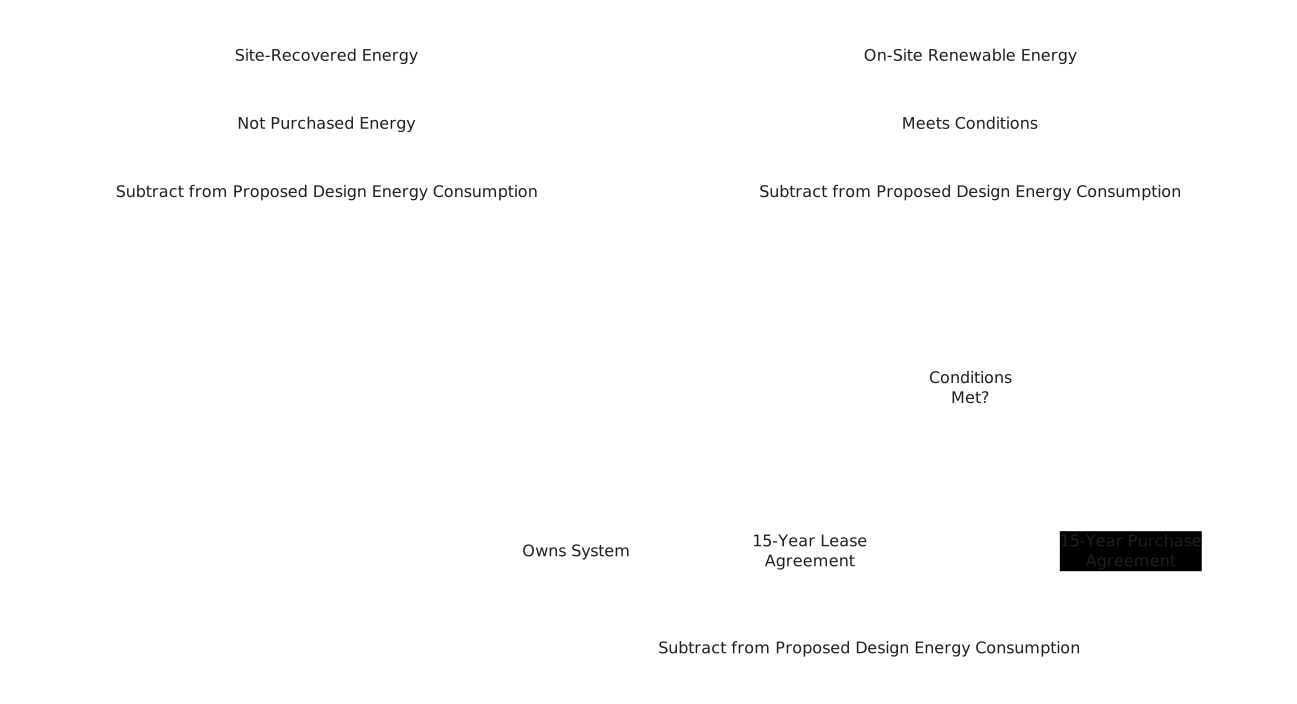
Site-recovered energy is not considered purchased energy and must be subtracted from the proposed design energy consumption prior to calculating the design energy cost.

On-site renewable energy must also be subtracted from the proposed design energy consumption prior to calculating the design energy cost, provided that the building owner meets one of the following conditions: owns the on-site renewable energy system, has signed a lease agreement for the system for at least 15 years, or has signed a contractual agreement to purchase energy generated by the system for at least 15 years.

circle-check

Annual Energy Costs

The design energy cost and energy cost budget must be determined using rates for purchased energy (such as electricity, gas, oil, propane, steam, and chilled water) that are approved by the adopting authority.

Where on-site renewable energy or site-recovered energy is used, the budget building design must be based on the energy source used as the backup energy source, or electricity if no backup energy source has been specified.

Where the proposed design includes on-site electricity generation systems other than on-site renewable energy systems, the baseline design must include the same generation systems excluding its site-recovered energy.

circle-check

Compliance Calculations

The design energy cost and energy cost budget must be calculated using the same simulation program, the same weather data, and the same purchased energy rates.

circle-check

Exceptional Calculation Methods

When the simulation program does not have the capability to model a specific design feature, material, or device, an exceptional calculation method must be used as approved by the authority having jurisdiction to demonstrate compliance with Section 11. Where there are multiple designs, materials, or devices that the simulation program cannot model, each must be calculated separately and exceptional savings determined for each.

All applications for approval of an exceptional calculation method must include the following: theoretical and empirical information verifying the method's accuracy and step-by-step documentation of the exceptional calculation method performed in sufficient detail to reproduce the results; copies of all spreadsheets used to perform the calculations; a sensitivity analysis of energy consumption when each of the input parameters that are estimated is varied from half to double the assumed value; calculations performed on a time-step basis consistent with the simulation program used; and the energy cost budget and design energy cost calculated both with and without the exceptional calculation methods to demonstrate the impact of the exceptional item.

circle-check

Calculation of Design Energy Cost and Energy Cost Budget

Simulation Model Development

The simulation model for calculating the design energy cost and the energy cost budget must be developed in accordance with the requirements in the table below.

Requirement
Proposed Design - Design Energy Cost (DEC)
Budget Building Design - Energy Cost Budget (ECB)

1. Design Model

The simulation model of the proposed design must be consistent with the design documents, including proper accounting of fenestration and opaque envelope types and area, interior lighting power and controls, HVAC system types, sizes, and controls, and service water-heating systems and controls.

All conditioned spaces in the proposed design must be simulated as being both heated and cooled, even if no cooling or heating system is being installed. Temperature and humidity control set points and schedules, as well as temperature control throttling range, must be the same for proposed design and baseline building design.

When the Energy Cost Budget Method is applied to buildings in which energy-related features have not yet been designed (e.g., a lighting system), those yet-to-be-designed features must be described in the proposed design so that they minimally comply with applicable mandatory and prescriptive requirements for HVAC, service hot water, power, lighting and other equipment. Where the space classification for a building is not known, the building must be categorized as an office building.

The budget building design must be developed by modifying the proposed design as described in this table. Except as specifically instructed in this table, all building systems and equipment must be modeled identically in the budget building design and proposed design.

2. Additions and Alterations

It is acceptable to demonstrate compliance using building models that exclude parts of the existing building, provided all of the following conditions are met:

• Work to be performed under the current permit application in excluded parts of the building must meet the requirements of Sections 5 through 10

• Excluded parts of the building are served by HVAC systems that are entirely separate from those serving parts of the building that are included in the building model

• Design space temperature and HVAC system operating set points and schedules on either side of the boundary between included and excluded parts of the building are identical

• If a declining block or similar utility rate is being used in the analysis and the excluded and included parts of the building are on the same utility meter, the rate must reflect the utility block or rate for the building plus the addition

Same as proposed design.

3. Space Use Classification

The building area type or space type classifications must be chosen in accordance with the Building Area Method of Calculating Interior Lighting Power Allowance or 9.6.1 Space-by-Space Method of Calculating Interior Lighting Power Allowance. The user or designer must specify the space use classifications using either the building area type or space type categories but must not combine the two types of categories within a single permit application. More than one building area type category may be used for a building if it is a mixed-use facility.

Exception: Where space types neither exist nor are designated in design documents, use type must be specified in accordance with the Building Area Method of Calculating Interior Lighting Power Allowance.

Same as proposed design.

4. Schedules

The schedule types for hourly variations in occupancy, lighting power, miscellaneous equipment power, thermostat set points, and HVAC system operation, defined separately for each day of the week and holidays are required input.

The schedules must be typical of the proposed design as determined by the designer and approved by the authority having jurisdiction. Required schedules must be identical for the proposed design and budget building design.

Temperature and humidity control set points and schedules, as well as temperature control throttling range, must be the same for proposed design and baseline building design.

Schedules for HVAC fans that provide outdoor air for ventilation must run continuously whenever spaces are occupied and must be cycled ON and OFF to meet heating and cooling loads during unoccupied hours.

Exceptions:

1. Where no heating and/or cooling system is to be installed, and a heating or cooling system is being simulated only to meet the requirements described in this table, heating and/or cooling system fans must not be simulated as running continuously during occupied hours but must be cycled ON and OFF to meet heating and cooling loads during all hours

2. HVAC fans must remain on during occupied and unoccupied hours in spaces that have health- and safety-mandated minimum ventilation requirements during unoccupied hours

3. Dedicated outdoor air supply fans must stay off during unoccupied hours

HVAC fans must remain on during occupied and unoccupied hours in systems primarily serving computer rooms.

Same as proposed design.

5. Building Envelope

All components of the building envelope in the proposed design must be modeled as shown on architectural drawings or as built for existing building envelopes.

Exceptions:

The following building elements are permitted to differ from architectural drawings:

1. Any building envelope assembly that covers less than 5% of the total area of that assembly type (e.g., exterior walls) need not be separately described. If not separately described, the area of a building envelope assembly must be added to the area of the adjacent assembly of that same type

2. Exterior surfaces whose azimuth orientation and tilt differ by less than 45 degrees and are otherwise the same may be described as either a single surface or by using multipliers

3. The exterior roof surface must be modeled using the aged solar reflectance and thermal emittance determined. Where aged test data are unavailable, the roof surface must be modeled with a solar reflectance of 0.30 and a thermal emittance of 0.90

4. Manually operated fenestration shading devices, such as blinds or shades, must not be modeled. Permanent shading devices, such as fins, overhangs, and light shelves, must be modeled

The budget building design must have identical conditioned floor area and identical exterior dimensions and orientations as the proposed design, except as follows:

• Opaque assemblies, such as roof, floors, doors, and walls, must be modeled as having the same heat capacity as the proposed design but with the minimum U-factor required in Section 5.5 for new buildings or additions and Section 5.1.3 for alterations

• The exterior roof surfaces must be modeled with a solar reflectance and thermal emittance as required. All other roofs must be modeled the same as the proposed design

• No shading projections are to be modeled; fenestration must be assumed to be flush with the wall or roof. If the fenestration area for new buildings or additions exceeds the maximum allowable, the area must be reduced proportionally along each exposure until the limit set in Section 5.5.4.2 is met. Fenestration U-factor and SHGC must be equal to the criteria from Tables 5.5-0 through 5.5-8 for the appropriate climate

• Skylights must be included in each thermal block when required by to meet the Minimum Skylight Fenestration Area

Exception:

When trade-offs are made between an addition and an existing building, the building envelope assumptions for the existing building in the budget building design must reflect existing conditions prior to any revisions that are part of this permit.

6. Lighting

Lighting power in the proposed design must be determined as follows:

• Where a complete lighting system exists, the actual lighting power for each thermal block must be used in the model

• Where a complete lighting system has been designed, lighting power for each thermal block must be determined in accordance with Installed Lighting Power and Interior and Exterior Luminaire Wattage requirements.

• Where no lighting exists or is specified, lighting power must be determined in accordance with the Building Area Method for the appropriate building area type

• Lighting system power must include all lighting system components shown or provided for on plans

• The lighting schedules in the proposed design must reflect the mandatory automatic lighting control requirements for Exterior Luminaire Wattage requirements.

• Automatic daylighting controls included in the proposed design may be modeled directly in the building simulation or through schedule adjustments

• Automatic lighting controls included in the proposed design but not required by Exterior Luminaire Wattage requirements must be modeled using standardized methods for occupancy sensors and other control factors

• Where a complete lighting system exists, lighting power in the budget building design must be the same as in the proposed design

• Where a lighting system has been designed, the interior lighting power allowance must be determined using either the Building Area Method or Space-by-Space Method with lighting power set equal to the maximum allowed. Additional interior lighting power for nonmandatory controls allowed under Additional Interior Lighting Power Using Nonmandatory Controls must not be included. Lighting power density in dwelling units must be 6.5 W/m²

• Where lighting neither exists nor is submitted with design documents, the lighting power in the budget building design must be the same as in the proposed design

• Power for fixtures not included in the lighting power calculation must be modeled identically

• Mandatory automatic lighting controls required by Exterior Luminaire Wattage requirements must be modeled the same as the proposed design

7. Thermal Blocks—HVAC Zones Designed

Where HVAC zones are defined on HVAC design drawings, each HVAC zone must be modeled as a separate thermal block.

Exceptions:

Different HVAC zones may be combined to create a single thermal block or identical thermal blocks to which multipliers are applied, provided that all of the following conditions are met:

1. The space-use classification is the same throughout the thermal block, or all of the zones have peak internal loads that differ by less than 31 W/m² from the average

2. All HVAC zones in the thermal block that are adjacent to glazed exterior walls face the same orientation or their orientations vary by less than 45 degrees

3. All of the zones are served by the same HVAC system or by the same kind of HVAC system

4. All of the zones have schedules that differ by 40 or less equivalent full-load hours per week

Same as proposed design.

8. Thermal Blocks—HVAC Zones Not Designed

Where the HVAC zones and systems have not yet been designed, thermal blocks must be defined based on similar internal load densities, occupancy, lighting, thermal and space temperature schedules, and in combination with the following:

• Separate thermal blocks must be assumed for interior and perimeter spaces (interior spaces are those located more than 4.6 m from an exterior wall)

• Separate thermal blocks must be assumed for spaces adjacent to glazed exterior walls; a separate zone must be provided for each orientation, except that orientations that differ by less than 45 degrees may be considered the same

• Separate thermal blocks must be assumed for spaces having floors in contact with ground or exposed to ambient conditions

• Separate thermal blocks must be assumed for spaces having exterior ceiling or roof assemblies

Same as proposed design.

9. Thermal Blocks—Multifamily Residential Buildings

Residential spaces must be modeled using at least one HVAC zone per dwelling unit except for those units with the same orientations, which may be combined into one thermal block. Corner units and units with roof or floor loads must only be combined with units sharing these features.

Same as proposed design.

10. HVAC Systems

The HVAC system type and all related performance parameters, such as equipment capacities and efficiencies, in the proposed design must be determined as follows:

• Where a complete HVAC system exists, the model must reflect the actual system type using actual component capacities and efficiencies

• Where an HVAC system has been designed, the HVAC model must be consistent with design documents. Mechanical equipment efficiencies must be adjusted from actual design conditions to the standard rating conditions specified in Section 6.4.1

• Where no heating system exists or has been specified, the heating system must be modeled as fossil fuel with characteristics identical to the budget building design

• Where no cooling system exists or has been specified, the cooling system must be modeled as an air-cooled single-zone system with characteristics identical to the budget building design

The HVAC system type and related performance parameters for the budget building design must be determined HVAC Systems, the system descriptions in Budget HVAC System Types and Budget HVAC System Specifications, and in accord with rules specified.

11. Service Water-Heating Systems

The service water-heating system type and all related performance parameters, such as equipment capacities and efficiencies, in the proposed design must be determined as follows:

• Where a complete service water-heating system exists, the model must reflect the actual system type using actual component capacities and efficiencies

• Where a service water-heating system has been designed and submitted with design documents, the service water-heating model must be consistent with design documents

• Where no service water-heating system exists or has been submitted with the design documents, no service water heating must be modeled<br><br>Piping losses must not be modeled.

The service water-heating system type in the budget building design must be identical to the proposed design. The service water-heating system performance of the budget building design must meet the requirements of Sections 7.4 and 7.5.

Exceptions:

1. If the service water-heating system type is not listed in Performance Requirements for Water-Heating Equipment—Minimum Efficiency Requirements, it must be determined based on Baseline Heating Method by Building Area Type

2. Where the 7.5 Prescriptive Compliance Path for Service Water Heating applies, the boiler must be split into a separate space-heating boiler and hot-water heater with efficiency requirements set to the least efficient allowed

3. For 24-hour facilities that meet the prescriptive criteria for use of condenser heat recovery systems described in Energy Recovery, such a system must be included in the baseline building design

Service water-heating energy consumption must be calculated explicitly based on the volume of service water heating required, the entering makeup water, and the leaving service water heating temperatures. Service water loads and use must be the same for both designs.

Piping losses must not be modeled.

12. Miscellaneous Loads

Receptacle, motor, and process loads must be modeled and estimated based on the building area type or space type category and must be assumed to be identical in the proposed and budget building designs. These loads must be included in simulations of the building and must be included when calculating the energy cost budget and design energy cost. All end-use load components within and associated with the building must be modeled, unless specifically excluded by Section 13 of Table 11.5.1, including but not limited to exhaust fans, parking garage ventilation fans, exterior building lighting, swimming pool heaters and pumps, elevators and escalators, and cooking equipment.

• Where power and other systems covered by Sections 8 and 10 have been designed and submitted with design documents, those systems must be determined in accordance with Sections 8 and 10

• Where power and other systems covered by Sections 8 and 10 have not been submitted with design documents, those systems must comply with but not exceed the requirements of those sections

Same as proposed design.

13. Refrigeration

Where refrigeration equipment in the proposed design is rated in accordance with AHRI 1200, the rated energy use must be modeled. Otherwise, the proposed design must be modeled using the actual equipment capacities and efficiencies.

Where refrigeration equipment is specified in the proposed design and listed in Electrically Operated DX-DOAS Units, Single-Package and Remote Condenser, without Energy Recovery— Minimum Efficiency Requirements, the budget building design must be modeled as as specified using the actual equipment capacities.

If the refrigeration equipment is not listed above, the budget building design must be modeled the same as the proposed design.

14. Modeling Exceptions

All elements of the proposed design building envelope, HVAC, service water heating, lighting, and electrical systems must be modeled in the proposed design in accordance with the requirements of Modeling Requirements for Calculating Design Energy Cost and Energy Cost Budget.

Exceptions: Components and systems in the proposed design may be excluded from the simulation model provided that:

1. Component energy use does not affect the energy use of systems and components that are being considered for trade-off and

2. The applicable prescriptive requirements of Sections 5.5, 6.5, 7.5, and either 9.5 or 9.6 applying to the excluded components are met

None.

Energy used to recharge or refuel vehicles that are used for off-building site transportation purposes is not required to be modeled for the design energy cost or the energy cost budget.

circle-check

HVAC Systems

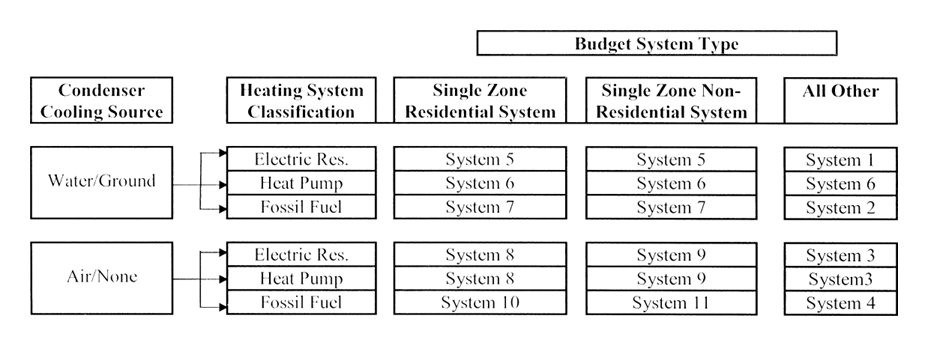
The HVAC system type and related performance parameters for the budget building design must be determined from the figure below, the system descriptions in Table 11.5.2-1 and accompanying notes, and the following rules.

Drawing

Budget HVAC System Types

System No.
System Type
Fan Control
Cooling Type
Heating Type

1

VAV with parallel fan-powered boxes a

VAV d

Chilled water e

Electric resistance

2

VAV with reheat b

VAV d

Chilled water e

Hot-water fossil fuel boiler f

3

Packaged VAV with parallel fan-powered boxes a

VAV d

Direct expansion c

Electric resistance

4

Packaged VAV with reheat b

VAV d

Direct expansion c

Hot-water fossil fuel boiler f

5

Two-pipe fan coil

Single- or two-speed fan i,j

Chilled water e

Electric resistance

6

Water-source heat pump

Single- or two-speed fan i,j

Direct expansion c

Electric heat pump and boiler g

7

Four-pipe fan-coil

Single- or two-speed fan i,j

Chilled water e

Hot-water fossil fuel boiler f

8

Packaged terminal heat pump

Single-speed fan i

Direct expansion c

Electric heat pump h

9

Packaged rooftop heat pump

Single- or two-speed fan i,j

Direct expansion c

Electric heat pump h

10

Packaged terminal air conditioner

Single-speed fan i

Direct expansion

Hot-water fossil fuel boiler f

11

Packaged rooftop air conditioner

Single- or two-speed fan i,j

Direct expansion

Fossil fuel furnace

Budget HVAC System Specifications

a. VAV with Parallel Fan-Powered Boxes

Fans in parallel VAV fan-powered boxes shall be sized for 50% of the peak design flow rate and shall be modeled with 0.74 W per L/s fan power. Minimum volume set points for fan-powered boxes shall be equal to the minimum rate for the space required for ventilation consistent with Exception 1(b) to Section 6.5.2.1. Supply air temperature set point shall be constant at the design condition (see Section 11.5.2[g]).

b. VAV with Reheat

Minimum volume set points for VAV reheat boxes shall be the larger of the following: the minimum primary outdoor airflow rate required to meet the Simplified Procedure ventilation requirements of ASHRAE Standard 62.1 for the zone or the airflow rate required to comply with applicable codes or accreditation standards, including but not limited to pressure relationships or minimum air change rates. The supply air temperature for cooling shall be reset higher by 2.8°C under the minimum cooling load conditions.

c. Direct Expansion

The fuel type for the cooling system shall match that of the cooling system in the proposed design.

d. VAV

The supply, return, or relief fan motor shall be modeled assuming a variable-speed drive and shall meet the VAV fan part-load performance requirements of Section G3.1.3.15. If the proposed design's system has a DDC system at the zone level, static pressure set-point reset based on zone requirements in accordance with Section 6.5.3.2.3 shall be modeled.

e. Chilled Water

For systems using purchased chilled water, the chillers are not explicitly modeled, and chilled-water costs shall be based as determined in Section 11.4.3. Otherwise, the budget building design's chiller plant shall be modeled with chillers having the number as indicated in Table 11.5.2-2 as a function of budget building design chiller plant load and type as indicated in Table 11.5.2-3 as a function of individual chiller load. Where chiller fuel source is mixed, the system in the budget building design shall have chillers with the same fuel types and with capacities having the same proportional capacity as the proposed design's chillers for each fuel type.

Chilled-water supply temperature shall be modeled at 6.7°C design supply temperature and 13°C return temperature. Piping losses shall not be modeled in either building model. Chilled-water supply water temperature shall be reset in accordance with Section 6.5.4.4. Pump system power for each pumping system shall be the same as for the proposed design; if the proposed design has no chilled-water pumps, the budget building design pump power shall be 349 kW/1000 L/s (equal to a pump operating against a 23 m head, 65% combined impeller and motor efficiency).

The chilled-water system shall be modeled as primary-only variable flow with flow maintained at the design rate through each chiller using a bypass. Chilled-water pumps shall be modeled as riding the pump curve or with variable-speed drives when required in Section 6.5.4.2. The heat-rejection device shall be an open-circuit axial-fan cooling tower with variable-speed fan control, if required in Section 6.5.5, and shall meet the performance requirements of Table 6.8.1-7.

Condenser water design supply temperature shall be calculated using the cooling tower approach to the 0.4% evaporation design wet-bulb temperature as generated by the formula below, with a design temperature rise of 5.6°C:

Approach (5.6°C Range) = 10.02 – (0.24 × WB)

where WB is the 0.4% evaporation design wet-bulb temperature in °C, valid for wet bulbs from 12.8°C to 32.2°C.

Except during economizer operation, the tower shall be controlled to maintain a cooling tower leaving water temperature, where weather permits, per Table 11.5.2-5, floating up to the design leaving water temperature for the cooling tower. Pump system power for each pumping system shall be the same as the proposed design; if the proposed design has no condenser water pumps, the budget building design pump power shall be 301 kW/1000 L/s (equal to a pump operating against a 18 m head, 60% combined impeller and motor efficiency). Each chiller shall be modeled with separate condenser water and chilled-water pumps interlocked to operate with the associated chiller.

f. Fossil Fuel Boiler

For systems using purchased hot water or steam, the boilers are not explicitly modeled and hot-water or steam costs shall be based on actual utility rates. Otherwise, the boiler plant shall use the same fuel as the proposed design and shall be natural draft. The budget building design boiler plant shall be modeled with a single boiler if the budget building design plant load is 176 kW or less and with two equally sized boilers for plant capacities exceeding 176 kW. Boilers shall be staged as required by the load.

Hot-water supply temperature shall be modeled at 82°C design supply temperature and 54°C return temperature. Piping losses shall not be modeled in either building model. Hot-water supply water temperature shall be reset in accordance with Section 6.5.4.4. Pump system power for each pumping system shall be the same as for the proposed design; if the proposed design has no hot-water pumps, the budget building design pump power shall be 301 kW/1000 L/s (equal to a pump operating against a 18 m head, 60% combined impeller and motor efficiency). The hot-water system shall be modeled as primary-only with continuous variable flow. Hot-water pumps shall be modeled as riding the pump curve or with variable-speed drives when required by Section 6.5.4.2.

g. Electric Heat Pump and Boiler

Water-source heat pumps shall be connected to a common heat pump water loop controlled to maintain temperatures between 16°C and 32°C. Heat rejection from the loop shall be provided by a closed-circuit axial-fan evaporative fluid cooler with fan-speed control as required in Section 6.5.5.2. Heat addition to the loop shall be provided by a boiler that uses the same fuel as the proposed design and shall be natural draft. If no boilers exist in the proposed design, the budget building boilers shall be fossil fuel.

The budget building design boiler plant shall be modeled with a single boiler if the budget building design plant load is 176 kW or less and with two equally sized boilers for plant capacities exceeding 176 kW. Boilers shall be staged as required by the load. Piping losses shall not be modeled in either building model. Pump system power shall be the same as for the proposed design; if the proposed design has no pumps, the budget building design pump power shall be 349 kW/1000 L/s, which is equal to a pump operating against a 23 m head, with a 65% combined impeller and motor efficiency. Loop flow shall be variable with flow shutoff at each heat pump when its compressor cycles OFF as required by Section 6.5.4.5. Loop pumps shall be modeled as riding the pump curve or with variable-speed drives when required by Section 6.5.4.2.

h. Electric Heat Pump

Electric air-source heat pumps shall be modeled with electric auxiliary heat. The system shall be controlled with a multistage space thermostat and an outdoor air thermostat wired to energize auxiliary heat only on the last thermostat stage and when outdoor air temperature is less than 4°C.

i. Fan System Operation

Fans shall be controlled in the same manner as in the proposed design; i.e., fan operation whenever the space is occupied or fan operation cycled ON calls for heating and cooling.

j. Fan Speed Control

Fans shall operate as one or two speed as required by Section 6.5.3.2, regardless of the fan speed control used in the proposed design.

Budget Building Systems Not Listed

Components and parameters not listed above or otherwise specifically addressed in this subsection must be identical to those in the proposed design. However, where there are specific requirements in the HVAC - Prescriptive Compliance Path and HVAC Alternative Compliance Paths, the component efficiency in the budget building design must be adjusted to the lowest efficiency level allowed by the requirement for that component type.

circle-check

Performance Requirements for Water-Heating Equipment—Minimum Efficiency Requirements

Equipment Type
Size Category (Input)
Subcategory or Rating Condition
Performance Required

Electric table-top water heaters

≤12 kW

≥76 L and ≤450 L, <309.75 W/L

For applications outside U.S., see footnote (h). For U.S. applications, see footnote (g).

Electric storage water heaters

≤12 kW

≥208 L and ≤309.75 W/L

For applications outside U.S., see footnote (h). For U.S. applications, see footnote (g).

>208 L and <454 L

For applications outside U.S., see footnote (h). For U.S. applications, see footnote (g).

>12 kW

<309.75 W/L

SL ≤ 0.3 + 27/Vm %/h

Electric instantaneous water heaters

≤12 kW

≥309.75 W/L, <7.6 L

For applications outside US, see footnote (h). For US applications, see footnote (g).

>12 kW and ≤58.6 kW

≥309.75 W/L, ≥7.6 L, ≤8.2°C

Very Small DP: UEF = 0.80<br>Low DP: UEF = 0.80<br>Medium DP: UEF = 0.80<br>High DP: UEF = 0.80

>58.6 kW

≥309.75 W/L, <38 L

No requirement

≥309.75 W/L, ≥38 L

No requirement

Gas storage water heaters

≤22 kW

<309.75 L, ≥75.7 L and ≤208 W/L

For applications outside U.S., see footnote (h). For U.S. applications, see footnote (g).

<208 L and ≤309.75 L

For applications outside U.S., see footnote (h). For U.S. applications, see footnote (g).

>22 kW and ≤31 kW

<309.75 W/L, ≤454 L, ≤82°C

Very Small DP: UEF = 0.2674 – (0.0009 × Vr)<br>Low DP: UEF = 0.5362 – (0.0012 × Vr)<br>Medium DP: UEF = 0.6002 – (0.0011 × Vr)<br>High DP: UEF = 0.6597 – (0.0009 × Vr)

>31 kW

<309.75 W/L

80% Et<br>SL ≤ (Q/800 + 0.0166 V), kW

Gas instantaneous water heaters

>14.6 kW and ≤58.6 kW

≥309.75 W/L, <7.57 L

For applications outside U.S., see footnote (h). For U.S. applications, see footnote (g).

>58.6 kW

≥309.75 W/L, <37.8 L

80% Et

>58.6 kW

≥309.75 W/L, ≥37.8 L

80% Et<br>SL ≤ (Q/800 + 0.0166 V), kW

Oil storage water heaters

≤30.8 kW

<309.75 W/L, <189 L

For applications outside U.S., see footnote (h). For U.S. applications, see footnote (g).

>30.8 kW and ≤41 kW

<309.75 W/L, <7.6 L, <82°C

Very Small DP: UEF = 0.2932 – (0.0015 × Vr)<br>Low DP: UEF = 0.5596 – (0.0018 × Vr)<br>Medium DP: UEF = 0.6194 – (0.0016 × Vr)<br>High DP: UEF = 0.6740 – (0.0013 × Vr)

>41 kW

<309.75 W/L

80% Et<br>SL ≤ (Q/800 + 0.0166 V), kW

Oil instantaneous water heaters

≤61 kW

≥309.75 W/L, <7.6 L

80% Et<br>EF ≥ 0.59 – 0.0005 × V

>61 kW

≥309.75 W/L, <37.85 L

80% Et

>61 kW

≥309.75 W/L, ≥37.85 L

78% Et<br>SL ≤ (Q/800 + 0.0166 V), kW

Hot-water supply boilers, gas and oil

≥88 kW and <3663 kW

≥309.75 W/L, <37.8 L

80% Et

Hot-water supply boilers, gas

≥88 kW and <3663 kW

≥309.75 W/L, ≥37.8 L

80% Et<br>SL ≤ (Q/800 + 0.0166 V), kW

Hot-water supply boilers, oil

≥88 kW and <3663 kW

≥309.75 W/L, ≥37.8 L

78% Et<br>SL ≤ (Q/800 + 0.0166 V), kW

Pool heaters, oil and gas

All

82% Et for commercial pool heaters and for applications outside U.S. For U.S. applications, see footnote (g).

Heat pump pool heaters

All

10°C db, 6.8°C wb outdoor air, 26.7°C entering water

4.0 COP

Unfired storage tanks

All

R-2.2

a. Thermal efficiency (Et) is a minimum requirement, while standby loss is a maximum requirement. In the standby loss equation, V is the rated volume in litres and Q is the nameplate input rate in kW. Standby loss for electric water heaters is in terms of %/h and denoted by the term "SL", and standby loss for gas and oil water heaters is in terms of kW and denoted by the term "SL." Vm is the measured volume in the tank in litres. Draw pattern (DP) refers to the water draw profile in the Uniform Energy Factor (UEF) test. UEF and Energy Factor (EF) are minimum requirements. In the UEF standard equations, Vr refers to the rated volume in litres.

b. Section 12 contains a complete specification, including the year version, of the referenced test procedure.

c. Electric instantaneous water heaters with input capacity >12 kW and ≤58.6 kW must comply with the requirements for >56 kW if the water heater either (1) has a storage volume >7.6 L; (2) is designed to provide outlet hot water at temperatures greater than 82°C; or (3) uses three-phase power.

d. Gas storage water heaters with input capacity >22 kW and ≤31 kW must comply with the requirements for the >30.7 kW if the water heater either (1) has a storage volume >454 L; (2) is designed to provide outlet hot water at temperatures greater than 82°C; or (3) uses three-phase power.

e. Oil storage water heaters with input capacity >31 kW and ≤41 kW must comply with the requirements for the >41 kW if the water heater either (1) has a storage volume >454 L; (2) is designed to provide outlet hot water at temperatures greater than 82°C; or (3) uses three-phase power.

f. Refer to Section 7.5.3 for additional requirements for gas storage and instantaneous water heaters and gas hot-water supply boilers.

g. Water heaters or gas pool heaters in this category or subcategory are regulated as consumer products by the USDOE as defined in 10 CFR 430.

h. Where this standard is being applied to a building outside the U.S. and Canada, and water heaters in this subcategory are being installed in that building, those water heaters shall meet the local efficiency requirements. If there are no local efficiency standards for residential water heaters, consideration should be given to using the USDOE efficiency requirements shown in Appendix F, Table F-2.

Baseline Heating Method by Building Area Type

Building Area Type
Baseline Heating Method

Automotive facility

Gas storage water heater

Convenience store

Electric resistance water heater

Convention center

Electric resistance storage water heater

Courthouse

Electric resistance storage water heater

Dining: Bar lounge/leisure

Gas storage water heater

Dining: Cafeteria/fast food

Gas storage water heater

Dining: Family

Gas storage water heater

Dormitory

Gas storage water heater

Exercise center

Gas storage water heater

Fire station

Gas storage water heater

Grocery store

Gas storage water heater

Gymnasium

Gas storage water heater

Health-care clinic

Electric resistance storage water heater

Hospital and outpatient surgery center

Gas storage water heater

Hotel

Gas storage water heater

Library

Electric resistance storage water heater

Manufacturing facility

Gas storage water heater

Motel

Gas storage water heater

Motion picture theater

Electric resistance storage water heater

Multifamily

Gas storage water heater

Museum

Electric resistance storage water heater

Office

Electric resistance storage water heater

Parking garage

Electric resistance storage water heater

Penitentiary

Gas storage water heater

Performing arts theater

Gas storage water heater

Police station

Electric resistance storage water heater

Post office

Electric resistance storage water heater

Religious facility

Electric resistance storage water heater

Retail

Electric resistance storage water heater

School/university

Gas storage water heater

Sports arena

Gas storage water heater

Town hall

Electric resistance storage water heater

Transportation

Electric resistance storage water heater

Warehouse

Electric resistance storage water heater

Workshop

Electric resistance storage water heater

All others

Gas storage water heater

Supply Fan Energy in Certain Package Equipment

Where efficiency ratings include supply fan energy, the efficiency rating must be adjusted to remove the supply fan energy. For Budget System Types 3, 4, 6, 8, 9, 10, and 11 (above), calculate the minimum COPnfcooling and COPnfheating using the equation for the applicable performance rating as indicated in Tables 6.8.1-1 through 6.8.1-4.

Electrically Operated Unitary Air Conditioners and Condensing Units—Minimum Efficiency Requirements

Equipment Type
Size Category
Heating Section Type
Subcategory or Rating Condition
Minimum Efficiency

Air conditioners, air cooled

<19 kW

All

Split system, three phase and applications outside U.S. single phase

3.81 SCOPC before 1/1/2023, 3.93 SCOP2C after 1/1/2023

All

Single-package, three phase and applications outside U.S. single phase

4.10 SCOPC before 1/1/2023, 3.93 SCOP2C after 1/1/2023

Space constrained, air cooled

≤9 kW

All

Split system, three phase and applications outside U.S. single phase

3.52 SCOPC before 1/1/2023, 3.43 SCOP2C after 1/1/2023

All

Single package, three phase and applications outside U.S. single phase

3.52 SCOPC before 1/1/2023, 3.43 SCOP2C after 1/1/2023

Small duct, high velocity, air cooled

<19 kW

All

Split system, three phase and applications outside U.S. single phase

3.52 SCOPC before 1/1/2023, 3.52 SCOP2C after 1/1/2023

Air conditioners, air cooled

≥19 kW and <40 kW

Electric resistance (or none)

Split system and single package

3.28 COPC, 3.78 ICOPC before 1/1/2023, 4.34 ICOPC after 1/1/2023

All other

3.22 COPC, 3.76 ICOPC before 1/1/2023, 4.28 ICOPC after 1/1/2023

≥40 kW and <70 kW

Electric resistance (or none)

3.22 COPC, 3.63 ICOPC before 1/1/2023, 4.16 ICOPC after 1/1/2023

All other

3.17 COPC, 3.58 ICOPC before 1/1/2023, 4.10 ICOPC after 1/1/2023

≥70 kW and <223 kW

Electric resistance (or none)

Split system and single package

2.93 COPC, 3.40 ICOPC before 1/1/2023, 3.87 ICOPC after 1/1/2023

All other

2.87 COPC, 3.34 ICOPC before 1/1/2023, 3.81 ICOPC after 1/1/2023

≥223 kW

Electric resistance (or none)

2.84 COPC, 3.28 ICOPC before 1/1/2023, 3.66 ICOPC after 1/1/2023

All other

2.78 COPC, 3.22 ICOPC before 1/1/2023, 3.60 ICOPC after 1/1/2023

Air conditioners, water cooled

<19 kW

All

Split system and single package

3.55 COPC, 3.60 ICOPC

≥19 kW and <40 kW

Electric resistance (or none)

3.55 COPC, 4.07 ICOPC

All other

3.49 COPC, 4.02 ICOPC

≥40 kW and <70 kW

Electric resistance (or none)

3.66 COPC, 4.07 ICOPC

All other

3.60 COPC, 4.02 ICOPC

≥70 kW and <223 kW

Electric resistance (or none)

3.63 COPC, 3.99 ICOPC

All other

3.58 COPC, 3.93 ICOPC

≥223 kW

Electric resistance (or none)

3.58 COPC, 3.96 ICOPC

All other

3.52 COPC, 3.90 ICOPC

Air conditioners, evaporatively cooled

<19 kW

All

Split system and single package

3.55 COPC, 3.60 ICOPC

≥19 kW and <40 kW

Electric resistance (or none)

3.55 COPC, 3.60 ICOPC

All other

3.49 COPC, 3.55 ICOPC

≥40 kW and <70 kW

Electric resistance (or none)

3.52 COPC, 3.58 ICOPC

All other

3.46 COPC, 3.52 ICOPC

≥70 kW and <223 kW

Electric resistance (or none)

3.49 COPC, 3.55 ICOPC

All other

3.43 COPC, 3.49 ICOPC

≥223 kW

Electric resistance (or none)

3.43 COPC, 3.49 ICOPC

All other

3.37 COPC, 3.43 ICOPC

Condensing units, air cooled

≥40 kW

3.08 COPC, 3.46 ICOPC

Condensing units, water cooled

≥40 kW

3.96 COPC, 4.10 ICOPC

Condensing units, evaporatively cooled

≥40 kW

3.96 COPC, 4.10 ICOPC

Electrically Operated Air-Cooled Unitary Heat Pumps—Minimum Efficiency Requirements

Equipment Type
Size Category
Heating Section Type
Subcategory or Rating Condition
Minimum Efficiency

Air cooled (cooling mode)

<19 kW

All

Split system, three phase and applications outside U.S. single phase b

4.10 SCOPC

before 1/1/2023

4.19 SCOP2C

after 1/1/2023

Single package, three phase and applications outside U.S. single phase b

4.10 SCOPC

before 1/1/2023

3.93 SCOP2C

after 1/1/2023

All

Split system, three phase and applications outside U.S. single phase b

4.10 SCOPC

before 1/1/2023

4.19 SCOP2C

after 1/1/2023

Space constrained, air cooled

(cooling mode)

£9 kW

All

Split system, three phase and applications outside U.S. single phase b

3.52 SCOPC

before 1/1/2023

3.42 SCOP2C

after 1/1/2023

Single package, three phase and applications outside U.S. single phase b

3.52 SCOPC

before 1/1/2023

3.42 SCOP2Cafter 1/1/2023

Small duct, high velocity, air cooled (cooling mode)

<19 kW

All

Split System, three phase and applications outside U.S. single phase b

4.10 SCOPC

before 1/1/2023

4.10 SCOP2C

after 1/1/2023

Air cooled (cooling mode)

³19 kW and

<40 kW

Electric resistance (or none)

Split system and single package

3.22 COPC

3.58 ICOPC

before 1/1/2023

4.13 ICOPC

after 1/1/2023

All other

3.17 COPC

3.52 ICOPC

before 1/1/2023

4.07 ICOPC

after 1/1/2023

³40 kW and

<70 kW

Electric resistance (or none)

3.11 COPC

3.40 ICOPC

before 1/1/2023

3.96 ICOPC

after 1/1/2023

All other

3.05 COPC

3.34 ICOPC

before 1/1/2023

3.90 ICOPC

after 1/1/2023

³70 kW

Electric resistance (or none)

2.78 COPC

3.11 ICOPC

before 1/1/2023

3.66 ICOPC

after 1/1/2023

All other

2.73 COPC

3.05 ICOPC

before 1/1/2023

3.60 ICOPC

after 1/1/2023

a. Section 12 contains a complete specification of the referenced test procedure, including the referenced year version of the test procedure.

b. Single-phase, U.S. air-cooled heat pumps <19 kW are regulated as consumer products by the U.S. Department of Energy Code of Federal Regulations 10 CFR

430. SCOPC, SCOP2C and SCOPH, and SCOP2H values for single-phase products are set by the U.S. Department of Energy.

Informative Note: See Informative Appendix F for the U.S. Department of Energy minimum.

Water-Chilling Packages—Minimum Efficiency Requirements

Equipment Type
Size Category
Units
Path A
Path B

Air-cooled chillers

<528 kW

COP (W/W)

≥2.985 FL<br>≥4.048 IPLV.SI

≥2.866 FL<br>≥4.669 IPLV.SI

≥528 kW

≥2.985 FL<br>≥4.137 IPLV.SI

≥2.866 FL<br>≥4.758 IPLV.SI

Air-cooled without condenser, electrically operated

All capacities

COP (W/W)

Air-cooled chillers without condenser must be rated with matching condensers and comply with air-cooled chiller efficiency requirements

Water-cooled, electrically operated positive displacement

<264 kW

COP (W/W)

≥4.694 FL<br>≥5.867 IPLV.SI

≥4.513 FL<br>≥7.041 IPLV.SI

≥264 kW and <528 kW

≥4.889 FL<br>≥6.286 IPLV.SI

≥4.694 FL<br>≥7.184 IPLV.SI

≥528 kW and <1055 kW

≥5.334 FL<br>≥6.519 IPLV.SI

≥5.177 FL<br>≥8.001 IPLV.SI

≥1055 kW and <2110 kW

≥5.771 FL<br>≥6.770 IPLV.SI

≥5.633 FL<br>≥8.586 IPLV.SI

≥2100 kW

≥6.286 FL<br>≥7.041 IPLV.SI

≥6.018 FL<br>≥9.264 IPLV.SI

Water-cooled, electrically operated centrifugal

<528 kW

COP (W/W)

≥5.771 FL<br>≥6.401 IPLV.SI

≥5.065 FL<br>≥8.001 IPLV.SI

≥528 kW and <1055 kW

≥5.771 FL<br>≥6.401 IPLV.SI

≥5.544 FL<br>≥8.801 IPLV.SI

≥1055 kW and <1407 kW

≥6.286 FL<br>≥6.770 IPLV.SI

≥5.917 FL<br>≥9.027 IPLV.SI

≥1407 kW and <2110 kW

≥6.286 FL<br>≥7.041 IPLV.SI

≥6.018 FL<br>≥9.264 IPLV.SI

≥2110 kW

≥6.286 FL<br>≥7.041 IPLV.SI

≥6.018 FL<br>≥9.264 IPLV.SI

Air-cooled absorption, single effect

All capacities

COP (W/W)

≥0.600 FL

NA

Water-cooled absorption, single effect

All capacities

COP (W/W)

≥0.700 FL

NA

Absorption double effect, indirect fired

All capacities

COP (W/W)

≥1.000 FL<br>≥1.050 IPLV.SI

NA

Absorption double effect, direct fired

All capacities

COP (W/W)

≥1.000 FL<br>≥1.000 IPLV.SI

NA

Electrically Operated Packaged Terminal Air Conditioners, Packaged Terminal Heat Pumps, Single-Package Vertical Air Conditioners, Single-Package Vertical Heat Pumps, Room Air Conditioners, and Room Air-Conditioner Heat Pumps—Minimum Efficiency Requirements

Equipment Type

Size Category (Input)

Subcategory or Rating Condition

Minimum Efficiency d

PTAC (cooling mode) standard size

<2.1 kW

35°C db/23.9°C wb

outdoor airc

3.49 COPC

³2.1 kW and

£4.4 kW

4.10 – (0.300 × Cap) COPC e

>4.4 kW

2.78 COPC

PTAC (cooling mode) nonstandard size a

<2.1 kW

35°C db/23.9°C wb

outdoor airc

2.75 COPC

³2.1 kW and

£4.4 kW

3.19 – (0.213 × Cap) COPC e

>4.4 kW

2.26 COPC

PTHP (cooling mode) standard size

<2.1 kW

35°C db/23.9°C wb

outdoor airc

3.49 COPC

³2.1 kW and

£4.4 kW

4.10 – (0.300 × Cap) COPC e

>4.4 kW

2.78 COPC

PTHP (cooling mode) nonstandard size b

<2.1 kW

35°C db/23.9°C wb

outdoor airc

2.73 COPC

³2.1 kW and

£4.4 kW

3.17 – (0.213 × Cap) COPC e

>4.4 kW

2.23 COPC

PTHP (heating mode) standard size

<2.1 kW

8.3°C db/6.1°C wb

outdoor air

3.3 COPH

³2.1 kW and

£4.4 kW

3.7 – (0.177 × Cap) COPH e

>4.4 kW

2.9 COPH

PTHP (heating mode) nonstandard size b

<2.1 kW

8.3°C db/6.1°C wb

outdoor air

2.7 COPH

³2.1 kW and

£4.4 kW

2.9 – (0.089 × Cap) COPH e

>4.4 kW

2.5 COPH

SPVAC (cooling mode) single and three phase

<19 kW

35°C db/23.9°C wb

outdoor airc

3.22 COPC

³19 kW and

<40 kW

2.93 COPC

³40 kW

and <70 kW

2.93 COPC

SPVHP (cooling mode)

<19 kW

35°C db/23.9°C wb

outdoor airc

3.22 COPC

³19 kW and

<40 kW

2.93 COPC

³40 kW

and <70 kW

2.93 COPC

SPVHP (heating mode)

<19 kW

8.3°C db/6.1°C wb

outdoor air

3.3 COPH

³19 kW and

<40 kW

3.0 COPH

³40 kW

and <70 kW

3.0 COPH

a. Section 12 contains a complete specification of the referenced test procedure, including the referenced year version of the test procedure.

b. Nonstandard size units must be factory labeled as follows: “MANUFACTURED FOR NONSTANDARD SIZE APPLICATIONS ONLY; NOT TO BE INSTALLED IN NEW STANDARD PROJECTS.” Nonstandard size efficiencies apply only to units being installed in existing sleeves having an external wall opening of less than 0.45 m high or less than 1.0 m wide and having a cross-sectional area less than 0.4 m2.

c. The cooling mode wet-bulb temperature requirement only applies for units that reject condensate to the condenser coil.

d. Room air conditioners are regulated as consumer products by 10 CFR 430. For U.S. applications of room air conditioners, refer to Appendix F, Table F-3 for USDOE minimum efficiency requirements.

e. “Cap” in COPC and COPH equations for PTACs and PTHPs means “cooling capacity” in kW at 35°C outdoor dry-bulb temperature.

6 Heating, Ventilating, and Air Conditioning

Table 6.8.1-4 Electrically Operated Packaged Terminal Air Conditioners, Packaged Terminal Heat Pumps, Single-Package Vertical Air Conditioners, Single-Package Vertical Heat Pumps, Room Air Conditioners, and Room Air-Conditioner Heat Pumps—Minimum Efficiency Requirements (Continued)

a. Section 12 contains a complete specification of the referenced test procedure, including the referenced year version of the test procedure.

b. Nonstandard size units must be factory labeled as follows: “MANUFACTURED FOR NONSTANDARD SIZE APPLICATIONS ONLY; NOT TO BE INSTALLED IN NEW STANDARD PROJECTS.” Nonstandard size efficiencies apply only to units being installed in existing sleeves having an external wall opening of less than 0.45 m high or less than 1.0 m wide and having a cross-sectional area less than 0.4 m2.

c. The cooling mode wet-bulb temperature requirement only applies for units that reject condensate to the condenser coil.

d. Room air conditioners are regulated as consumer products by 10 CFR 430. For U.S. applications of room air conditioners, refer to Appendix F, Table F-3 for USDOE minimum efficiency requirements.

e. “Cap” in COPC and COPH equations for PTACs and PTHPs means “cooling capacity” in kW at 35°C outdoor dry-bulb temperature.

Electrically Operated Packaged Terminal Air Conditioners, Packaged Terminal Heat Pumps, Single-Package Vertical Air Conditioners, Single-Package Vertical Heat Pumps, Room Air Conditioners, and Room Air Conditioner Heat Pumps— Minimum Efficiency Requirements

Where multiple HVAC zones are combined into a single thermal block, the efficiencies for budget System Types 6, 8, and 10 taken from Tables 6.8.1-1 through 6.8.1-4 must be based on 2.6 kW equipment capacity for residential spaces; otherwise, it must be based on the capacity of the thermal block divided by the number of HVAC zones. Budget System Types 3, 4, 9, and 11 efficiencies taken from Tables 6.8.1-1 through 6.8.1-4 must be based on the cooling equipment capacity of a single floor when grouping identical floors.

Where a full- and part-load efficiency rating is provided in Tables 6.8.1-1 through 6.8.1-4, the following full-load equations must be used:

  • COPnfcooling = 9.13E-4 × COPC × Q + 1.15 × COPC

  • COPnfcooling = –0.0885 × SCOPC² + 1.295 × SCOPC (applies to cooling efficiency only)

  • COPnfheating = 5.05E-4 × COPH8.3 × Q + 1.062 × COPH8.3 (applies to Systems 6 and 9 heating efficiency only)

  • COPnfheating = –0.3446 × SCOPH² + 2.434 × SCOPH

  • COPnfcooling = 1.1338 × COP – 0.2145 (applies to Systems 8 and 10 cooling efficiency only)

  • COPnfheating = 1.1329 × COP – 0.214 (applies to System 8 heating efficiency only)

Where COPnfcooling and COPnfheating are the packaged HVAC equipment cooling and heating energy efficiency, respectively, to be used in the budget building design, which excludes supply fan power, and Q is the AHRI-rated cooling capacity in kW. If Q is greater than 223 kW, use 223 kW in the calculation. COPC, SCOPC, SCOPH8.3, and SCOPH must be at AHRI test conditions. Fan energy must be modeled separately according to Section 11.5.2(h). Supply and return/relief system fans must be modeled as operating at least whenever the spaces served are occupied, except as specifically noted in Table 11.5.2-1.

circle-check

Minimum Outdoor Air Ventilation Rate

Minimum outdoor air ventilation rates must be the same for both the budget building design and proposed design. Exhaust air heat recovery must be modeled for the budget building design in accordance with Section 6.5.6.1.

However, when modeling demand control ventilation in the proposed design for spaces where demand control ventilation is not required per Section 6.4.3.8, or where the minimum outdoor air intake flow in the proposed design is provided in excess of the amount required by Section 6.5.3.7, the baseline building design must be modeled to reflect the minimum amount required by Section 6.5.3.7.

circle-check

Electrically Operated DX-DOAS Units, Single-Package and Remote Condenser, without Energy Recovery—Minimum Efficiency Requirements

Equipment Type
Subcategory or Rating Condition
Minimum Efficiency

Air cooled (dehumidification mode)

1.8 ISMRE

Air source heat pumps (dehumidification mode)

1.8 ISMRE

Water cooled (dehumidification mode)

Cooling tower condenser water

2.2 ISMRE

Chilled Water

2.7 ISMRE

Air source heat pump (heating mode)

1.2 ISCOP

Water source heat pump (dehumidification mode)

Ground source, closed loop

2.2 ISMRE

Ground-water source

2.3 ISMRE

Water source

1.8 ISMRE

Water source heat pump (heating mode)

Ground source, closed loop

2.0 ISCOP

Ground-water source

3.2 ISCOP

Water source

3.5 ISCOP

Economizers

Budget building systems as listed in Table 11.5.2-1 must have air economizers or fluid economizers, the same as in the proposed design, in accordance with Section 6.5.1. The high-limit shutoff must be in accordance with Table 11.5.2-4.

circle-check

Preheat Coils

If the proposed design system has a preheat coil, the budget building design's system must be modeled with a preheat coil controlled in the same manner.

circle-check

Supply Airflow Rates

System design supply air rates for the budget building design must be based on a supply-air-to-room temperature set-point difference of 11°C or the minimum outdoor airflow rate, or the airflow rate required to comply with applicable codes or accreditation standards, whichever is greater.

For systems with multiple zone thermostat set points, use the design set point that will result in the lowest supply air cooling set point or highest supply air heating set point. If return or relief fans are specified in the proposed design, the budget building design must also be modeled with fans serving the same functions and sized for the budget system supply fan air quantity less the minimum outdoor air, or 90% of the supply fan air quantity, whichever is larger.

For systems serving laboratory spaces, airflow rate must be based on a supply-air-to-room temperature set-point difference of 9°C or the required ventilation air or makeup air, whichever is greater. If the proposed design HVAC system airflow rate based on latent loads is greater than the design airflow rate based on sensible loads, then the same supply-air-to-room-air humidity ratio difference used to calculate the proposed design airflow must be used to calculate design airflow rates for the budget building design.

circle-check

Fan System Efficiency

Fan system efficiency (input kW per L/s of supply air, including the effect of belt losses but excluding motor and motor drive losses) must be the same as the proposed design or up to the limit prescribed in Section 6.5.3.1, whichever is smaller. If this limit is reached, each fan must be proportionally reduced in input kW until the limit is met. Fan electrical power must then be determined by adjusting the calculated fan kW by the minimum motor efficiency prescribed by Section 10.4.1 for the appropriate motor size for

circle-check

Equipment Capacities

The equipment capacities for the budget building design must be sized proportionally to the capacities in the proposed design based on sizing runs, meaning the ratio between the capacities used in the annual simulations and the capacities determined by the sizing runs must be the same for both the proposed design and budget building design. Unmet load hours for the proposed design or baseline building designs must not exceed 300 hours (of the 8760 hours simulated). The unmet load hours for the proposed design must not exceed the unmet load hours for the budget building design.

Alternatively, unmet load hours exceeding these limits may be approved by the building official, provided that sufficient justification is given indicating that the accuracy of the simulation is not significantly compromised by these unmet loads.

circle-check

Determining the HVAC System

Each HVAC system in a proposed design is mapped on a one-to-one correspondence with one of eleven HVAC systems in the budget building design. To determine the budget building system, follow these steps:

1

Step 1

Enter Figure 11.5.2 at "Water" if the proposed design system condenser is water or evaporatively cooled; enter at "Air/None" if the condenser is air cooled. Closed-circuit dry coolers are considered air cooled. Systems utilizing district cooling are treated as if the condenser water type were "water." If no mechanical cooling is specified or the mechanical cooling system in the proposed design does not require heat rejection, the system is treated as if the condenser water type were "Air." For proposed designs with ground-source or groundwater-source heat pumps, the budget system must be water-source heat pump (System 6).

2

Step 2

Select the path that corresponds to the proposed design heat source: electric resistance, heat pump (including air source and water source), or fuel-fired. Systems utilizing district heating (steam or hot water) are treated as if the heating system type were "Fossil Fuel." Systems with no heating capability are treated as if the heating system type were "Fossil Fuel." For systems with mixed fuel heating sources, the system or systems that use the secondary heating source type (the one with the smallest total installed output capacity for the spaces served by the system) must be modeled identically in the budget building design, and the primary heating source type must be used in Figure 11.5.2 to determine budget system type.

3

Step 3

Select the budget building design system category. The system under "Single-Zone Residential System" must be selected if the HVAC system in the proposed design is a single-zone system and serves a residential space. The system under "Single-Zone Nonresidential System" must be selected if the HVAC system in the proposed design is a single-zone system and serves other than residential spaces. The system under "All Other" must be selected for all other cases.

circle-check

Kitchen Exhaust

For kitchens with a total exhaust hood airflow rate greater than 2400 L/s, use a demand ventilation system on 75% of the exhaust air. The system must reduce exhaust and replacement air system airflow rates by 50% for one half of the kitchen occupied hours in the baseline building design. If the proposed design uses demand ventilation, the same airflow rate schedule must be used. The maximum exhaust flow rate allowed for the hood or hood section must meet the requirements of Section 6.5.7.2.2 for the numbers and types of hoods and appliances provided in the proposed design.

circle-check

Last updated

Was this helpful?