> For the complete documentation index, see [llms.txt](https://docs.betterbuilding.io/llms.txt). Markdown versions of documentation pages are available by appending `.md` to page URLs; this page is available as [Markdown](https://docs.betterbuilding.io/user-guide/workflows/energy-efficiency/ashrae-90.1-2019/ashrae-90.1-economic-tariff-structures.md).
# ASHRAE 90.1 Economic Tariff Structures
ASHRAE 90.1-2019 Appendix G uses energy cost as its compliance metric. The proposed building's annual energy cost must be less than or equal to the baseline building's annual energy cost, which means the tariff structure you select isn't just a reporting detail; it's a pass/fail variable.
This was a meaningful shift from earlier versions of the standard that focused primarily on energy consumption. Under the cost-based approach, a building that uses more energy could still comply if that energy is cheaper (think fuel switching, or shifting loads to off-peak periods). Conversely, a building with lower consumption might fail if it's consuming expensive energy at expensive times.
Better Building calculates these costs through the EnergyPlus `UtilityCost:Tariff` objects, which model the rate structures defined below. Selecting the wrong tariff type, or misconfiguring the one you've chosen, will skew the cost comparison between proposed and baseline buildings.
Best case, you waste time troubleshooting results that don't make sense. Worst case, a building that should comply appears to fail (or vice versa), and you get to have an uncomfortable conversation with a plans examiner about why your numbers don't add up.
The tariff types available in Better Building cover most rate structures you'll encounter in practice, from simple flat rates to complex time-of-use and real-time pricing schemes. Understanding what each one actually models helps you match your simulation to the utility rate the building will actually see, or to whatever reference rates your jurisdiction specifies for Appendix G compliance.
### The Tariff Types
#### Monthly Fixed
A flat charge applied every billing period regardless of how much energy the building consumes. This is your basic customer charge, service fee, meter charge, or whatever your utility calls it. The building could sit empty and dark, and you'd still owe this amount. In Better Building, it's typically a constant value in dollars per month.
#### Monthly Variable
A charge that changes month to month but isn't directly tied to energy consumption or demand in the conventional sense. This might be indexed to fuel costs, adjusted for regulatory riders, or calculated from some other variable external factor. It's the catch-all for "we need a monthly charge that isn't fixed and isn't a standard energy or demand calculation."
#### Annual Energy
A flat rate per unit of energy ($/kWh or $/therm) that remains constant across all twelve months. Simple to understand, simple to model. The same rate applies whether it's January or July, midnight or noon. Many simplified utility analyses use this approach because it keeps the math tractable, even if real utility bills are rarely this straightforward.
#### Seasonal Energy
Energy charges that vary by season, typically summer versus winter, though some utilities define shoulder seasons as well. Summer rates are usually higher for electricity (air conditioning load) while winter rates may be higher for gas (heating load). Better Building lets you define which months belong to which season and apply different $/kWh rates accordingly.
#### Annual Demand
A charge based on peak power draw (kW for electricity), applied consistently throughout the year. The utility looks at your highest demand during the billing period and charges accordingly. This reflects the utility's need to maintain generation and distribution capacity for your worst-case scenario, even if you only hit that peak for fifteen minutes in August.
#### Seasonal Demand
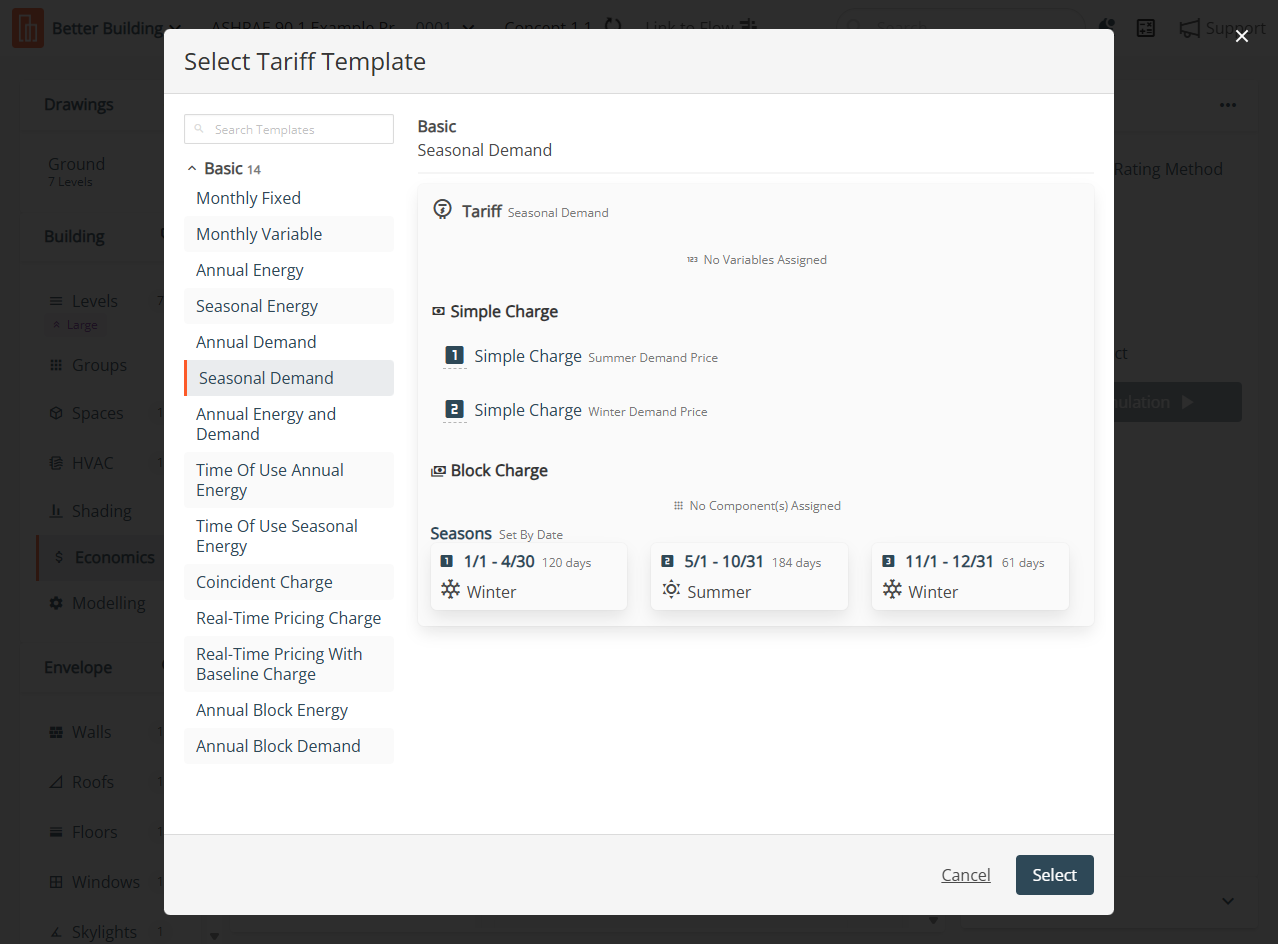
Demand charges that shift based on season. Summer demand charges are frequently higher than winter for electric utilities because that's when the grid is most stressed. The structure acknowledges that a 500 kW peak in July costs the utility more to serve than the same peak in March.
#### Annual Energy and Demand
A combination tariff that includes both volumetric energy charges ($/kWh) and demand charges ($/kW) calculated on an annual basis with consistent rates year-round. This is the workhorse structure for commercial buildings. You pay for how much energy you use and for how quickly you use it at peak times. Most commercial electric rates follow this general pattern.
#### Time Of Use Annual Energy
Energy charges that vary by time of day (on-peak, off-peak, sometimes mid-peak or shoulder periods) but maintain those same time-differentiated rates throughout the entire year. The utility is signaling that electricity at 2 PM costs more than electricity at 2 AM, but they're not layering seasonal variations on top. The rate schedule might show peak hours as 12-6 PM at $0.15/kWh and off-peak at $0.08/kWh, and those numbers hold regardless of month.
#### Time Of Use Seasonal Energy
The more complex (and more realistic) cousin of TOU Annual. Energy charges vary both by time of day and by season. Summer on-peak might be $0.18/kWh while winter on-peak is $0.12/kWh, with corresponding shifts in off-peak rates. This structure captures the reality that a kWh at 3 PM in August has very different grid implications than a kWh at 3 PM in February.
#### Coincident Charge
A coincident charge bases your demand charge not on YOUR building's individual peak, but on your demand at the time of the system peak (the utility's overall maximum demand). If the grid peaks at 4:30 PM on July 23rd, your coincident demand is whatever your building was drawing at that moment, even if your building's own peak was at a completely different time. This incentivizes load shifting away from system-critical periods. Modeling this accurately requires either knowing when system peaks occur or making reasonable assumptions about them.
#### Real-Time Pricing Charge
Energy charges that fluctuate based on actual wholesale market prices, sometimes updated hourly or even more frequently. The price you pay at 10 AM literally depends on what the market was doing at 10 AM. This exposes building operators to price volatility but also creates opportunities for responsive buildings to save money by reducing consumption during price spikes. EnergyPlus can model this using external price schedules, though you need to provide the price signal data.
#### Real-Time Pricing With Baseline Charge
A variation on real-time pricing commonly used in demand response programs. You establish a baseline consumption pattern (what you'd normally use), and the real-time pricing applies to deviations from that baseline. If prices spike and you reduce consumption below your baseline, you might actually get credited. If you consume above baseline during high prices, you pay the premium on the excess. The baseline component provides some cost predictability while the real-time component provides the incentive signal.
#### Annual Block Energy
Tiered or block energy rates applied on an annual basis. The first X kWh per year might cost $0.08/kWh, the next Y kWh costs $0.10/kWh, and anything above that threshold costs $0.12/kWh. This structure either rewards conservation (inclining blocks, where rates increase with consumption) or provides volume discounts (declining blocks, where rates decrease with consumption). The annual timeframe means the blocks reset each year rather than each month.
#### Annual Block Demand
The demand-side equivalent of block rates. Your first 100 kW of demand might be charged at $8/kW, the next 100 kW at $10/kW, and so on. Like annual block energy, the thresholds operate on a yearly basis. This structure is less common than block energy rates but appears in some industrial tariffs where utilities want to either encourage or discourage large demand installations depending on their system needs.
***
### Practical Notes for Modeling
When setting up tariffs in Better Building for ASHRAE 90.1 compliance, the standard typically specifies using either actual utility rates or, for Appendix G analyses, rates based on published EIA data or state averages. The tariff structure you select should match the actual rate schedule the building will be billed under (for ECB) or the reference rates specified by the rating authority (for Appendix G).
Getting this wrong doesn't just affect the bottom-line cost number. It can change which energy conservation measures appear cost-effective and, in some compliance pathways, whether the building passes at all.
---
# Agent Instructions
This documentation is published with GitBook. GitBook is the documentation platform designed so that both humans and AI agents can read, navigate, and reason over technical content effectively. Learn more at gitbook.com.
## Querying This Documentation
If you need additional information that is not directly available in this page, you can query the documentation by asking a question.
Perform an HTTP GET request on the following URL with the `ask` and `goal` query parameters:
```
GET https://docs.betterbuilding.io/user-guide/workflows/energy-efficiency/ashrae-90.1-2019/ashrae-90.1-economic-tariff-structures.md?ask=&goal=
```
`ask` is the immediate question: it should be specific, self-contained, and written in natural language.
`goal` is what the user is ultimately trying to achieve, the reason they need the answer. Sharing it helps GitBook give you a better, more relevant answer. A goal is most helpful when it describes the outcome the user wants rather than restating the question. For example, with `ask=how do I create an API token`, a goal like `automate deployments from our CI pipeline` lets GitBook tailor the answer to that use case.
The response will contain a direct answer to the question and relevant excerpts and sources from the documentation.
Use this mechanism when the answer is not explicitly present in the current page, you need clarification or additional context, or you want to retrieve related documentation sections.