> For the complete documentation index, see [llms.txt](https://docs.betterbuilding.io/llms.txt). Markdown versions of documentation pages are available by appending `.md` to page URLs; this page is available as [Markdown](https://docs.betterbuilding.io/user-guide/workflows/dew-point.md).
# Dew Point
### Dew Point Modelling on Speckel
ISO 13788 focuses on assessing interstitial condensation risks by considering influential factors like temperature gradients, humidity levels, material diffusion resistance, and vapour pressure profiles.
{% hint style="info" %}
ISO 13788, titled *“Hygrothermal performance of building components and building elements – Internal surface temperature to avoid critical surface humidity and interstitial condensation – Calculation methods,”* provides guidelines to prevent surface condensation by maintaining internal surface temperatures above the dew point and to assess interstitial condensation risks by evaluating temperature and vapour pressure gradients within building components.
{% endhint %}
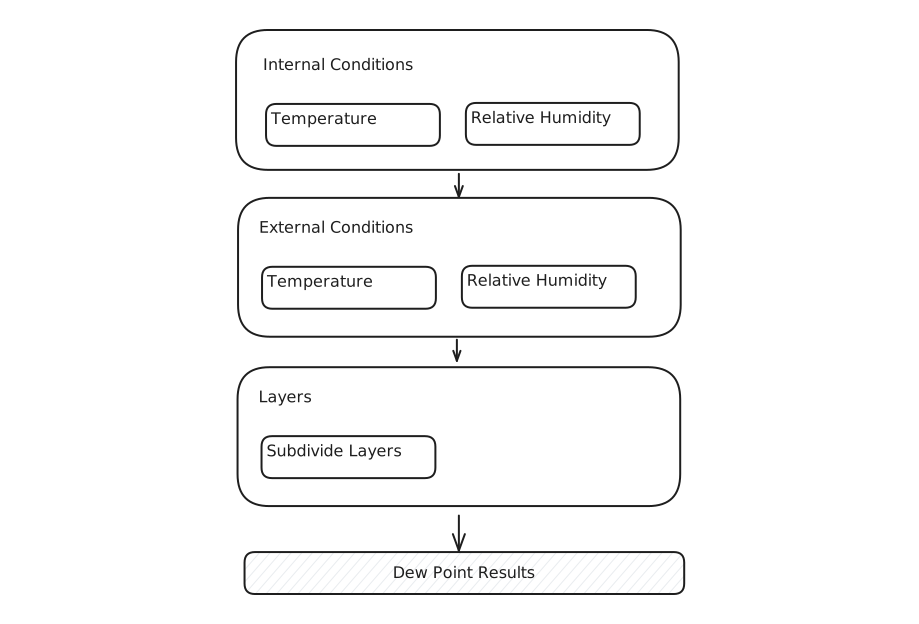
Below is a step-by-step outline of the required inputs for Dew Point simulations, calibrated to align with ISO 13788 standard.
 ### ISO 13788 Limitations
ISO 13788 does not account for several critical physical phenomena, including:
* Variations in material properties with moisture content,
* Capillary suction and liquid moisture transfer within materials,
* Air movement into the component via gaps or air spaces,
* Hygroscopic moisture capacity of materials.\
Thus, the method applies only when these phenomena can be deemed negligible.
{% hint style="danger" %}
Due to the stated limitations above, we recommend dynamic moisture simulations are undertaken where any risk is identified when undertaking a Dew Point assessment as per ISO 13788.
{% endhint %}
---
# Agent Instructions
This documentation is published with GitBook. GitBook is the documentation platform designed so that both humans and AI agents can read, navigate, and reason over technical content effectively. Learn more at gitbook.com.
## Querying This Documentation
If you need additional information that is not directly available in this page, you can query the documentation by asking a question.
Perform an HTTP GET request on the following URL with the `ask` and `goal` query parameters:
```
GET https://docs.betterbuilding.io/user-guide/workflows/dew-point.md?ask=&goal=
```
`ask` is the immediate question: it should be specific, self-contained, and written in natural language.
`goal` is what the user is ultimately trying to achieve, the reason they need the answer. Sharing it helps GitBook give you a better, more relevant answer. A goal is most helpful when it describes the outcome the user wants rather than restating the question. For example, with `ask=how do I create an API token`, a goal like `automate deployments from our CI pipeline` lets GitBook tailor the answer to that use case.
The response will contain a direct answer to the question and relevant excerpts and sources from the documentation.
Use this mechanism when the answer is not explicitly present in the current page, you need clarification or additional context, or you want to retrieve related documentation sections.
### ISO 13788 Limitations
ISO 13788 does not account for several critical physical phenomena, including:
* Variations in material properties with moisture content,
* Capillary suction and liquid moisture transfer within materials,
* Air movement into the component via gaps or air spaces,
* Hygroscopic moisture capacity of materials.\
Thus, the method applies only when these phenomena can be deemed negligible.
{% hint style="danger" %}
Due to the stated limitations above, we recommend dynamic moisture simulations are undertaken where any risk is identified when undertaking a Dew Point assessment as per ISO 13788.
{% endhint %}
---
# Agent Instructions
This documentation is published with GitBook. GitBook is the documentation platform designed so that both humans and AI agents can read, navigate, and reason over technical content effectively. Learn more at gitbook.com.
## Querying This Documentation
If you need additional information that is not directly available in this page, you can query the documentation by asking a question.
Perform an HTTP GET request on the following URL with the `ask` and `goal` query parameters:
```
GET https://docs.betterbuilding.io/user-guide/workflows/dew-point.md?ask=&goal=
```
`ask` is the immediate question: it should be specific, self-contained, and written in natural language.
`goal` is what the user is ultimately trying to achieve, the reason they need the answer. Sharing it helps GitBook give you a better, more relevant answer. A goal is most helpful when it describes the outcome the user wants rather than restating the question. For example, with `ask=how do I create an API token`, a goal like `automate deployments from our CI pipeline` lets GitBook tailor the answer to that use case.
The response will contain a direct answer to the question and relevant excerpts and sources from the documentation.
Use this mechanism when the answer is not explicitly present in the current page, you need clarification or additional context, or you want to retrieve related documentation sections.