> For the complete documentation index, see [llms.txt](https://docs.betterbuilding.io/llms.txt). Markdown versions of documentation pages are available by appending `.md` to page URLs; this page is available as [Markdown](https://docs.betterbuilding.io/user-guide/2d-building/building/hvac/plant-hvac/air-handling-unit/heating-coil.md).
# Heating Coil
A Heating Coil is a component within HVAC systems designed to raise air or water temperature for space heating. It typically consists of coils through which hot water or steam flows. The coil transfers thermal energy to the passing air, contributing to the heating process.
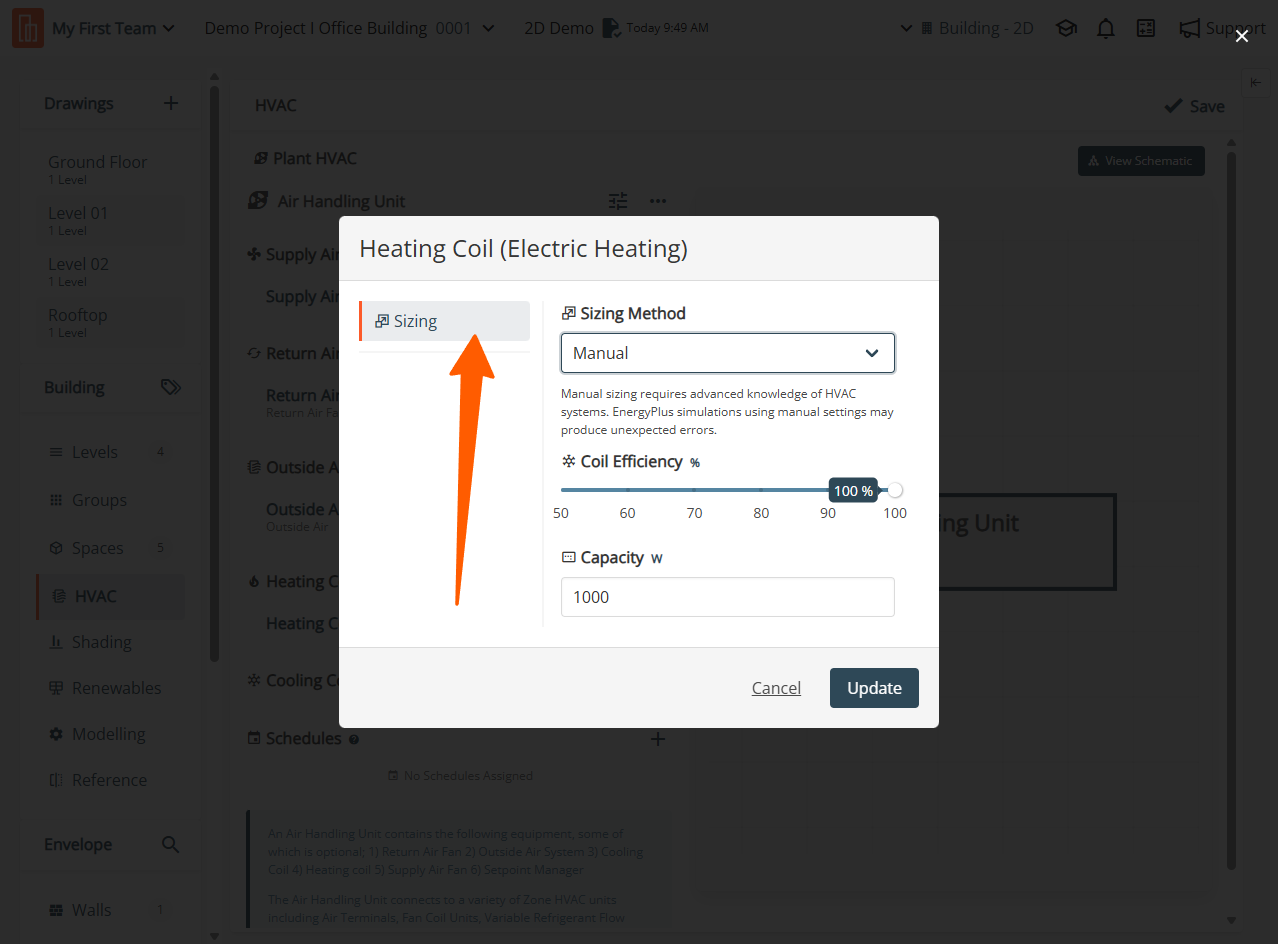
## Heating Coil (Electric Heating)
### Sizing Method
Specify the Sizing Method by choosing between Autosize and Manual. If Manual is selected, ensure all required sizing parameters are specified.
### Coil Efficiency
Specify the Coil Efficiency, entered as a decimal (not a percentage). Typically, this value is 100% for electric coils, accounting for minimal losses.
### Capacity
Specify the Capacity, setting the maximum capacity of the coil in watts (W). The controlled coil will adjust its output to meet the criteria, be it temperature or capacity control, ensuring efficient operation based on the specified maximum capacity.
## Heating Coil (Water Heating)
### Sizing Method
Specify the Sizing Method by choosing between Autosize and Manual. If Manual is chosen, provide all necessary sizing parameters as required.
### Max. Water Flow Rate
Specify the maximum possible water flow rate (in cubic meters per second, m3/sec) through the coil. This information is utilized when the Coil Performance Input Method is set to U Factor Times Area And Design Water Flow Rate.
### Capacity
Specify the Capacity by setting the maximum capacity of the coil in watts (W). The controlled coil will adjust its output to meet control criteria, whether temperature or capacity-controlled, providing only the necessary capacity.
### Inlet Air Temp
Specify the Inlet Air Temperature, measured in degrees Celsius, corresponding to the rated heating capacity. The default value is 16.6.
### Inlet Water Temp
Specify the Inlet Water Temperature, measured in degrees Celsius, corresponding to the rated heating capacity. The default value is 82.2.
### Output Air Temp.
Specify the Output Air Temperature, measured in degrees Celsius (°C), corresponding to the nominal heating capacity. The default value is 32.2.
### Output Water Temp.
Specify the Output Water Temperature, measured in degrees Celsius, corresponding to the rated heating capacity. The default value is 71.1.
### Ratio for Air and Water Convection
Specify the Ratio for Air and Water Convection, representing the convective heat transfer ratio between the air side and water side of the heating coil at rated operating conditions. The default value is 0.5.
{% hint style="info" %}
Only on Premium Plans. Please reach for further [support](https://app.gitbook.com/o/WS5BGzA70OvplUrfmCf1/s/fKJnzF2TwHA3APPbiCpF/~/changes/232/support-and-training/contact-us).
{% endhint %}
---
# Agent Instructions
This documentation is published with GitBook. GitBook is the documentation platform designed so that both humans and AI agents can read, navigate, and reason over technical content effectively. Learn more at gitbook.com.
## Querying This Documentation
If you need additional information that is not directly available in this page, you can query the documentation by asking a question.
Perform an HTTP GET request on the following URL with the `ask` and `goal` query parameters:
```
GET https://docs.betterbuilding.io/user-guide/2d-building/building/hvac/plant-hvac/air-handling-unit/heating-coil.md?ask=&goal=
```
`ask` is the immediate question: it should be specific, self-contained, and written in natural language.
`goal` is what the user is ultimately trying to achieve, the reason they need the answer. Sharing it helps GitBook give you a better, more relevant answer. A goal is most helpful when it describes the outcome the user wants rather than restating the question. For example, with `ask=how do I create an API token`, a goal like `automate deployments from our CI pipeline` lets GitBook tailor the answer to that use case.
The response will contain a direct answer to the question and relevant excerpts and sources from the documentation.
Use this mechanism when the answer is not explicitly present in the current page, you need clarification or additional context, or you want to retrieve related documentation sections.