> For the complete documentation index, see [llms.txt](https://docs.betterbuilding.io/llms.txt). Markdown versions of documentation pages are available by appending `.md` to page URLs; this page is available as [Markdown](https://docs.betterbuilding.io/user-guide/2d-building/building/hvac/hvac-templates/system-no.-9-heating-furnace-and-ventilation.md).
# System No. 9 Heating (Furnace) and Ventilation
A Heating (Furnace) and Ventilation system, as defined in EnergyPlus HVACTemplate, is a climate control system commonly used in commercial and industrial buildings where cooling is not required or is provided by other means. It consists of a central air handling unit (AHU) that supplies heated and ventilated air through ductwork to serve one or multiple zones throughout the building.
The central AHU includes a gas furnace or other heating source, filters, and fans to condition and distribute air. The system draws outdoor air for ventilation through the central AHU and circulates heated air as needed to maintain space temperatures during heating seasons. Fans within the unit distribute the conditioned air throughout the space, ensuring effective temperature control and adequate ventilation.
This configuration is particularly suitable for applications in mild climates, warehouses, or spaces where heating and ventilation are the primary HVAC requirements.
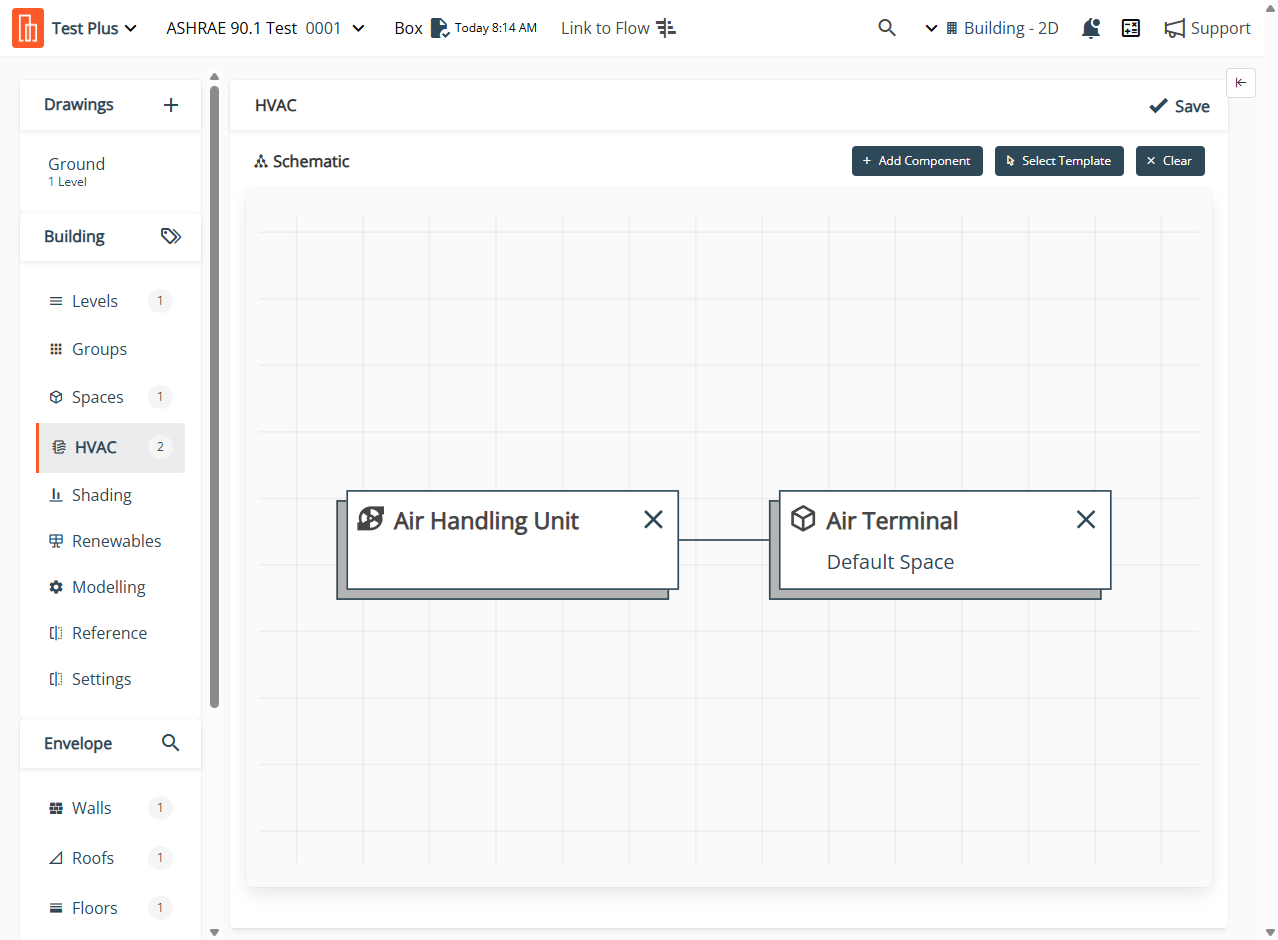
A Heating (Furnace) and Ventilation system comprises:
* Plant HVAC component - Air Handling Unit
* Space HVAC component - Air Terminal
The 'Select HVAC Template' form allows for multiple Spaces to be served. Clicking into the 'Spaces' field shows a list of available Spaces. Each selected Space will have one Heating and Ventilation Zone Space HVAC component, providing heating and ventilation for that space.
---
# Agent Instructions
This documentation is published with GitBook. GitBook is the documentation platform designed so that both humans and AI agents can read, navigate, and reason over technical content effectively. Learn more at gitbook.com.
## Querying This Documentation
If you need additional information that is not directly available in this page, you can query the documentation dynamically by asking a question.
Perform an HTTP GET request on the current page URL with the `ask` query parameter, and the optional `goal` query parameter:
```
GET https://docs.betterbuilding.io/user-guide/2d-building/building/hvac/hvac-templates/system-no.-9-heating-furnace-and-ventilation.md?ask=&goal=
```
`ask` is the immediate question: it should be specific, self-contained, and written in natural language.
`goal` is optional and describes the broader end goal you are ultimately trying to accomplish on behalf of the user. GitBook uses it to tailor the answer towards what is most useful for that goal.
The response will contain a direct answer to the question and relevant excerpts and sources from the documentation.
Use this mechanism when the answer is not explicitly present in the current page, you need clarification or additional context, or you want to retrieve related documentation sections.