> For the complete documentation index, see [llms.txt](https://docs.betterbuilding.io/llms.txt). Markdown versions of documentation pages are available by appending `.md` to page URLs; this page is available as [Markdown](https://docs.betterbuilding.io/support-and-training/other-support/faqs/building/calculate-discharge-coefficients.md).
# Calculate Discharge Coefficients
A discharge coefficient (Cd) is a crucial parameter in fluid dynamics and building physics, especially in the context of natural ventilation through windows.
It quantifies the ease with which air can pass through an opening, such as a window, under pressure differences. A higher Cd indicates a more efficient flow of air through the window.
Any prefered equation can be used to adopt a Cd value. Better Building recommends BB101, which adopts the definitions recommended by the CIBSE Natural Ventilation Group for free area, effective area and equivalent area. A spreadsheet can be downloaded below, for ease of calculation.
{% file src="/files/vL86nLyi88jNA0Ww2RXm" %}
{% hint style="info" %}
Download BB 101: Ventilation, thermal comfort and indoor air quality 2018 [here](https://www.gov.uk/government/publications/building-bulletin-101-ventilation-for-school-buildings)
{% endhint %}
## **Components of Discharge Coefficient Calculation**
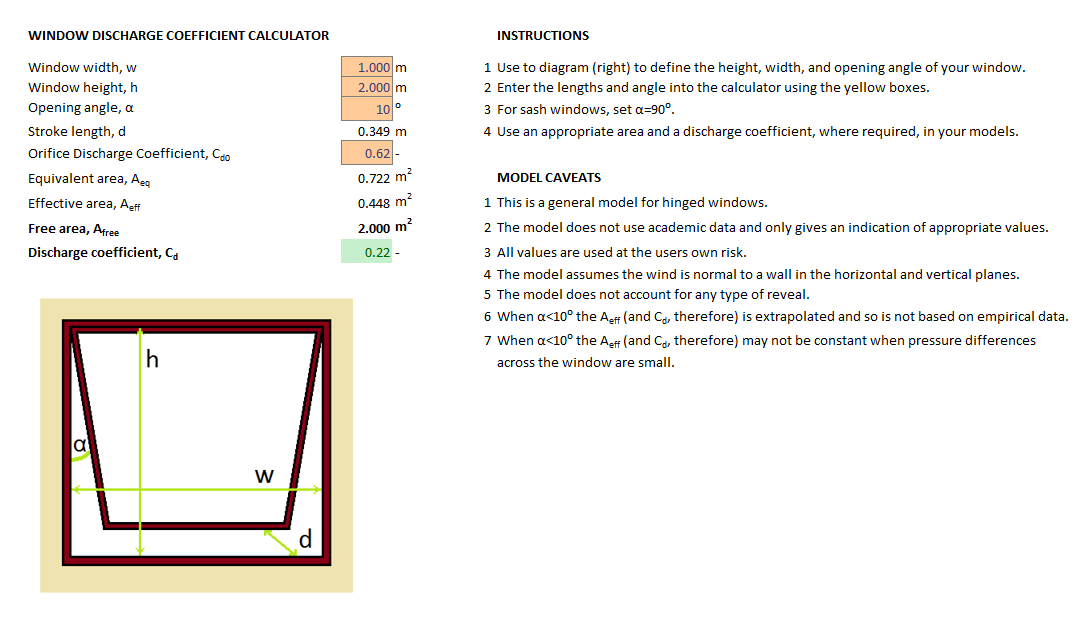
To calculate a Cd value, the following inputs need to be provided. These are then used within an Airflow Network to calculate the impact on a model. Instructions are provided in the spreadsheet.
### **Window Dimensions**
The width (w) and height (h) of the window are essential dimensions that define the size of the opening through which air will flow. These dimensions influence the overall free area available for air passage.
### **Opening Angle (α)**
This is the angle at which the window is opened. It significantly impacts the effective area (Aeff) through which air flows. For hinged windows, this angle can vary, whereas for sash windows, it is typically set to 90°.
### **Stroke Length (d)**
This is the distance by which the window is opened. It contributes to determining the effective opening area.
### **Orifice Discharge Coefficient (**Cd0**)**
This coefficient, typically a value between 0.62 and 1.0, represents the ideal discharge coefficient for a sharp-edged orifice under standard conditions.
### **Equivalent Area (Aeq)**
This is a theoretical area that represents the window opening considering the discharge coefficient. It simplifies the comparison between different window designs and their airflow capabilities.
### **Effective Area (Aeff)**
This is the actual area available for airflow, adjusted by the discharge coefficient. It reflects the true performance of the window in facilitating ventilation.
### **Free Area (Afree)**
This is the physical area of the window opening without considering the discharge coefficient. It represents the maximum potential area for airflow.
---
# Agent Instructions
This documentation is published with GitBook. GitBook is the documentation platform designed so that both humans and AI agents can read, navigate, and reason over technical content effectively. Learn more at gitbook.com.
## Querying This Documentation
If you need additional information that is not directly available in this page, you can query the documentation dynamically by asking a question.
Perform an HTTP GET request on the current page URL with the `ask` query parameter, and the optional `goal` query parameter:
```
GET https://docs.betterbuilding.io/support-and-training/other-support/faqs/building/calculate-discharge-coefficients.md?ask=&goal=
```
`ask` is the immediate question: it should be specific, self-contained, and written in natural language.
`goal` is optional and describes the broader end goal you are ultimately trying to accomplish on behalf of the user. GitBook uses it to tailor the answer towards what is most useful for that goal.
The response will contain a direct answer to the question and relevant excerpts and sources from the documentation.
Use this mechanism when the answer is not explicitly present in the current page, you need clarification or additional context, or you want to retrieve related documentation sections.